The Deeper Read 19
Imtiaz Dharker

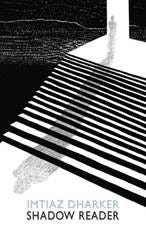
“What goes of your father?” from Shadow Reader (Bloodaxe, 2024).
Imtiaz’s website is here.
Content note: Violence against women
What goes of your father?

Surpanakha, the demon’s sister, spits

So! I am too forward, too loose,
full-mouth make-up, rusted hair,
bells and rings on my toes, tattoo
too well-placed, too in your face,
double body, single clothes. What goes?
Tell! What goes of your father?

So, I am not one of these but maybe
one of those? My demon brother has ten heads
and twenty hands, but I am under no man’s
thumb, out of control of fatherbrotheruncleson,
queening and loafing in my forest alone.
What goes, eh? What goes of your father?

So? Not pure, not demure, not shy,
I choose to be too much, too much myself,
out of bounds for you. Admit you liked it, no?
Unzipped your halo? Your holiness slipped?
Brave hero! Comecome! Cut off
my ears my nipples my nose. What goes?

So who is to judge, whose the sin?
I will change shape, grow myself back again.
Sharpen my wits to match my nails,
spit on my hands, slap my thighs.

Let the battle begin.

Imtiaz Dharker
Dharker’s gloriously recalcitrant poem is fittingly spiky, given that its speaker is the rakshasi (demoness) Surpanakha, her name in Sanskrit meaning ‘she whose fingernails are like winnowing fans’. Traditionally seen as a ‘minor’ character in the Ramayana, her actions in revenge against her abuse at the hands of Rama and his brother Lakshmana in fact drive the plot (Wikipedia). It is fitting that the title itself is a question, hurled at both the reader and the men, setting the tone for a speaker who in total uses twelve question marks and four exclamation marks.
The title opens the poem with an accusatory question which is in fact an ultimatum; an idiom attributed to Emerson meaning ‘mind your own business’. As the epigraph shows, Surpanakha doesn’t say or ask it, she “spits”, deflecting the implied questions asked of her and instead demanding that the ‘hero’ justify himself instead. After this question, the first line begins with an exclamation: “So!”. Having got our attention, Dharker’s demoness delivers an unapologetic spiel of all the ways – thoroughly intentional – in which she is excessive, owning her own blazon:
So! I am too forward, too loose,
full-mouth make-up, rusted hair,
bells and rings on my toes, tattoo
too well-placed, too in your face,
double body, single clothes.
(1-5).
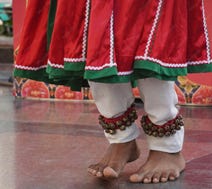
The first line deals with the clichéd insults hurled at women who refuse to be passive: that they are pushy or morally delinquent. There follows a sensory list of how she embodies this in her appearance: lipstick, hennaed hair, jewellery and body art. The punctuation does a lot of heavy lifting here: most lines are end-stopped by commas, slowing the pace and allowing us to take in the lavish imagery, as well as characterising a speaker who follows nobody’s timetable but her own, “queening and loafing in my forest” (11). The exclamation and question marks are textual signifiers of her loudness, and the bells on her feet become a physical manifestation of this.
Repeated use of the ‘oo’ [u] sound both echoes and intensifies the feeling of being too much: “too” appears four times in this first stanza, and we also see “loose” (1) and the deft line break “tattoo / too well-placed” (3-4); the only line in this stanza to enjamb. If vowels are the air in a poem (Maxwell), then these are no sensuous croon, but rather a howling blast of rage from a woman who claims her body and customises it as she pleases for her own gaze, so plentiful that she constitutes a “double body”, unconstrained by and spilling out of “single clothes”. The hyphenated compound words – almost kennings (Gardner) – add to the sense of excess. All of this richness is shrugged off with the two questions and an exclamation which end the stanza: “What goes? / Tell! What goes of your father?” (5-6). Yes, I am all of this. What business is it of yours?
The second stanza also begins “So,” this time with a comma instead of an exclamation mark. The tone appears more conversational than abrasive, but another question is coming: “So, I am not one of these but maybe / one of those?” (7-8). She flaunts her otherness, pivoting on another expertly enjambed line break, defying definition by any patriarchal terms: whether the slurs reserved for unruly women or the double standards exalting male violence and dominance:
My demon brother has ten heads
and twenty hands, but I am under no man’s
thumb, out of control of fatherbrotheruncleson,
(8-10).
Compared to “ten heads / and twenty hands”, her own “double body” seems modest; yet the joke is that even her demon brother cannot rule her; he may have “twenty hands”, but she is nonetheless “under no man’s / thumb, out of control”, the line break deliciously delaying the pun. Not even the grotesque monster of male familial authority – “fatherbrotheruncleson”, spilling over the end of one of the longest lines in the poem – can “control” her; she lives in her own space by her own rules: “queening and loafing in my forest alone.” (11). Well shot of the domestic sphere, she has achieved not merely ‘a room of one’s own’ (Woolf) but an entire forest; a queendom. In the light of this, the refrain “What goes, eh? What goes of your father?” (12) now sounds sarcastic as well as challenging: mind your own pathetic business, because my business is way out of your league.

The anaphora “So?” returns at the start of the third stanza, this time evolving to a question, the unspoken phrase ‘so what?’ hanging over another fiercely unrepentant inventory, this time of everything she is not:
So? Not pure, not demure, not shy,
I choose to be too much, too much myself,
out of bounds for you.
(13-15).
These anti-attributes remind us that the story posits Surpanakha as “in sharp contrast to Sita’s character, who is generally considered to be the epitome of feminine qualities and virtues” (Dirghangi and Mohanty 8-9). The purposely twee internal rhyme of “pure” and “demure” (13) implies ridicule, reminding us of Jools Lebron’s ironic “very demure, very mindful” TikTok post (which I should say post-dates the publication of Shadow Reader); the resulting memeification of both words rendering them devoid of actual meaning. The slant rhyme of the end words “shy” (13) and “myself” (14) speaks volumes: she would far rather be the latter than the former. In this, she is “out of bounds” for the male characters in a far more alarming sense than a traditionally ‘virtuous’ woman, because she relies purely on self-defence, not the protection of patriarchal systems.
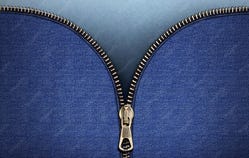
In the Ramayana, Surpanakha woos first Rama then his brother and is rejected by both; in this poem, she slyly suggests they recognise both their attraction to her unruliness and the fact that they can’t handle her: “out of bounds for you. Admit you liked it, no? / Unzipped your halo? Your holiness slipped?” (15-16). The questions come thick and fast in an unholy trinity: she doesn’t wait for an answer, she already knows. Unlike her proud, overflowing “double body” (5), the heroes are inadvertently exposed and shamed. “Unzipped” is a deliberately unusual choice of verb for a halo; it may slant rhyme with the more usual “slipped”, but Dharker deliberately evokes the modern Western sense of a man unzipping his flies for a sexual act, caught out in a moment of involuntary lust.
In sonnet terms, this would be the volta of the poem, two-thirds of the way through, and there is a shift from interrogation to mockery: “Brave hero! Comecome! Cut off / my ears my nipples my nose. What goes?” (17-18). An armed man attacking a woman is anything but brave, of course, but she taunts him with the sexually punning invitation “Comecome” even as he severs “my ears my nipples my nose” (18). The commas that dignified her earlier self-blazon have gone: she is now a mere shopping list of body parts. If these are too defiant to be sexually exploited then they must be disfigured, in a searing echo of female mutilation from saints’ martyrdoms in the Christian tradition (Butler) to the abuse of female bodies that persists today worldwide: denial of access to contraception or abortion, sexual violence, impossible ‘beauty’ standards, FGM. Surpanakha may end this stanza with her defiant refrain of “What goes” (18), but it now reads as elegy. What goes, for women? Abuse, still. What is going to change?
The final full stanza has some ideas, contracting to a sharp quatrain after the three preceding sestets: “So who is to judge, whose the sin?” (19). The questions are now rhetorical, and this time there is no pausing punctuation after “So”. The speaker is judge; the sinner those whom she addresses, and she has a plan for their punishment:
I will change shape, grow myself back again.
Sharpen my wits to match my nails,
spit on my hands, slap my thighs.
(20-22).
They have tried to reduce her “double body” by cutting parts off her, most significantly her nose, seen in many cultures as a symbol of female honour (Frembgen): hydra-like, she will not only regrow but also “change shape”, indefinable once more, impossible to pin down. Each abuse has taught her something; enabled her to “Sharpen my wits to match” her legendary nails. Now she performs a war dance reminiscent of the Black Ferns, the New Zealand women’s rugby team, performing the famous Māori haka: “spit on my hands, slap my thighs.” (22), the stanza breaking to allow us to take this in before she utters the war cry “Let the battle begin.” (23).
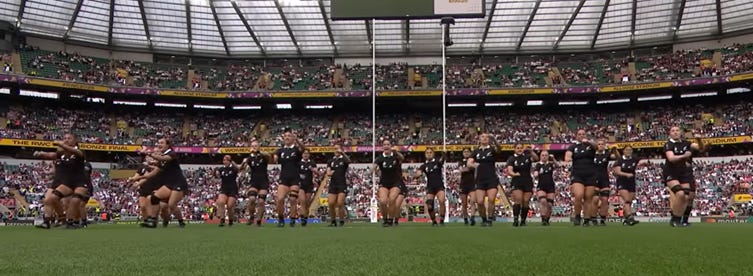
Source: Word Rugby, YouTube, youtu.be/tCyqnBr-WXM?si=hJ2RKZqrj71RgGba
It takes supreme confidence to end a poem on an orphan line: it has to be a hell of a line. This is, and it’s made all the more devastating by the addition of the definite article. ‘Let battle begin’ might seem a more obvious choice, putting the plosive alliteration together. But that would be too neat for Dharker’s liberated, “loose” demoness and would also miss the point: this is not just any battle.
This is the battle, the battle against violence against women, which is emphatically not a battle against men but rather against the patriarchy, a system constructed by and favouring the most powerful men and oppressive of everyone else, regardless of which gender they identify with. The extra syllable also makes the final line of the poem anapaestic dimeter – dee dee DUM dee dee DUM – and we can hear her hands slap her thighs like war drums, the epitome of weaponised womanhood. As Dharker said at a reading for the StAnza Well Versed series: for her, Shadow Reader is “mostly to do with who takes possession of a story, and how it changes depending on who takes possession of it.” (2:10). In this poem, Surpanakha seizes ownership of herself and her story, and the battle for truth begins.
*******
Something I like to do when reading poems is to see what poem is created by the end words, a kind of golden shovel in reverse. Here’s the end word poem from this piece, with a line for each stanza, keeping each word’s original punctuation. As ever, this reveals fascinating patterns within the poem. Nearly all the end words in the first stanza are parts of Surpanakha’s body, defiantly flaunted. This is in sharp contrast to the male nouns which dominate the line endings in the second stanza, including the grotesque chimera “fatherbrotheruncleson” (10), almost as many-headed as her “demon brother” (8). Question marks are threaded throughout, evoking the speaker’s demand that the patriarchy explain itself. Her chaos slowly infects the poem’s structure, and by the fourth stanza the sestets dissolve to a quatrain, as diminished as the mutilated speaker appears to be, but ready to “grow myself back again” (20). Who knows where the final orphan line will lead? All we know is that “the battle” is about to “begin” (23).
loose, hair, tattoo face, goes? father?

maybe heads man’s fatherbrotheruncleson, alone. father?

shy, myself, no? slipped? off goes?

sin? again. nails, thighs.

begin.
*******
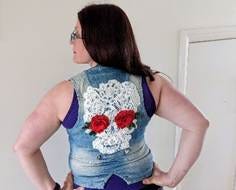
Each week, I’ll share a poem of my own if I think I’ve one which chimes with the poem under discussion. Here’s “Denim and Skulls”, part of a sequence in which I explore the clothes I wear and why, drawing on the satirical tradition of burlesque and reclaiming blazon from the patriarchal male gaze. Both waistcoat and necklace are real. First published in Abridged 0 – 105 “Lilith”, edited by Susanna Galbraith and Gregory McCartney.
Denim and Skulls

Frida’s flores de Muerto bleed
from the eyes of a calavera, glare
between my shrugging shoulder blades:
stitched in reclaimed lace, a doily
serving an ofrenda. Eat me: mind
your teeth on metal buttons, stamped
with ampersands. They’re following
each other’s tails: and and and
black as sockets – you assume
they look at you, but they pursue
their own desires. I protect
my neck with a choker, tattoo-tight
above a silver pendant stating
my intention: fuck this shit.


flores de Muerto – Mexican marigolds
calavera – decorated skull
ofrenda – offering of food to the dead

Suzanna Fitzpatrick
Works Cited
All Blacks. “Black Ferns Haka: Ko Uhia Mai (Let It Be Known).” YouTube, 12 May 2021, youtu.be/0ikmASNtjuk?si=SiM7yTdTxTmaFANC. Accessed 14 May 2026.
Butler, K. Bevin. “Mutilated Martyrs: Gendered Violence & “Becoming Male” in an Antependium of Virgin Martyrs.” Religions 17, no. 3:368, 2026. doi.org/10.3390/rel17030368. Accessed 14 May 2026.
Dharker, Imtiaz. “Well Versed 2025 with Imtiaz Dharker.” StAnza: Scotland’s International Poetry Festival, YouTube, 28 October 2025, www.youtube.com/watch?v=EqhtQ-BRIL8&list=PL_bXWCbSdgVuZ8tPTm2Sh_wmf2A2vJyAe. Accessed 13 May 2026.
Dirghangi, Aditi and Seemita Mohanty. “De-mythifying the Ramayana: A Study of the ‘Devoiced’ Surpanakha.” Proceeding of the 6th International Conference on Arts and Humanities, Vol. 6, 2019, pp. 8-15. doi.org/10.17501/23572744.2019.6102. Accessed 13 May 2026.
Frembgen, Jürgen Wasim. “Honour, Shame, and Bodily Mutilation. Cutting off the Nose among Tribal Societies in Pakistan.” Journal of the Royal Asiatic Society, vol. 16, no. 3, 2006, pp. 243–60. JSTOR, www.jstor.org/stable/25188646. Accessed 14 May 2026.
Gardner, Thomas. “The Old English Kenning: A Characteristic Feature of Germanic Poetical Diction?” Modern Philology vol. 67 no. 2, November 1969, The University of Chicago Press. doi.org/10.1086/390147. Accessed 14 May 2026.
Hindustan Times. “What Goes of your Father?” Hindustan Times, 14 May 2012, www.hindustantimes.com/entertainment/what-goes-of-your-father/story-s9lOzAFzMhdA4TZFmbxemN.html. Accessed 13 May 2026.
Major, Kirsty. “‘Very demure, very mindful’: how Jools Lebron went viral – and her life fell apart.” The Guardian, 14 May 2026, www.theguardian.com/society/2026/may/14/very-demure-very-mindful-how-jools-lebron-went-viral-and-her-life-fell-apart?CMP=share_btn_url. Accessed 14 May 2026.
Maxwell, Glyn. “Building Blocks of Form: Formal and Free.” Masterclass 1.8, 27 February 2024, The Poetry School. Seminar. Notes taken by me.
Talwar, Shyaonti. “Handy Lessons From Soorpanakha’s Story For Today’s Woman.” Feminism in India, 21 January 2021, feminisminindia.com/2021/01/21/soorpanakha-nose-honour-feminism/. Accessed 13 May 2026.
Wikipedia. “Shurpanakha.” Wikipedia, 15 March 2026, en.wikipedia.org/wiki/Shurpanakha. Accessed 13 May 2026.
Woolf, Virginia. A Room of One’s Own/Three Guineas, OUP, 1992.
What strikes me most in your reading is how well you track the punctuation as body language — the exclamation marks as physical loudness, the commas as someone who "follows nobody's timetable but their own." That's an insight I'll carry into my own close reading for a while. Dharker's poem performs what it describes: excessive, end-stopped, refusing to be rushed.
The kenning observation around "fatherbrotheruncleson" is beautifully placed. It's a monster made of syllables, and yet she stands outside it — the line break doing exactly the work you describe, deliciously delaying the pun. There's something almost comic about that line, which makes the violence that follows even more shocking.
"Denim and Skulls" is a strong poem, and a worthy companion to Dharker's. It holds its own.