The Deeper Read 21
Hanne Busck-Nielsen

“ma griffe”, first published in the anthology Infinite Riches of a Little Room: Poems from the Back Room Poets, Oxford, 1919 – 2016, edited by Merryn Williams (AB Press).
Hanne’s website is here.
Content note: addiction.
ma griffe

“My grief” came your quick reply. Without any French
but a sniff at English, you mistranslated brilliantly
and ‘Ma Griffe’ was the closest I got to you.
I long for its woody, balsamic note.

Your scent criss-crossed my childhood –
acrid stocking-toes out of stilettos, cigarettes, boiled coffee
the sweet whiff off your Mary Quant black and silver daisy box
and that fragrant scale of Dubonnet to Aquavit –

Dubonnet on your breath: good to fair.
Chardonnay: breezy. Carlsberg: heavy showers.
Aalborg Aquavit: severe weather warning –
for this I kept a torch and Donald Duck weeklies under my bed.

Bottles were translucent gods. Deluded cocky gods.
My sense of smell is highly educated –
it hunts you down even now, the way the past turns up
in funny places – can pick you out in any crowd. But I digress.

Your signature runs aldehydic in my veins. I must write it out.

Hanne Busck-Nielsen
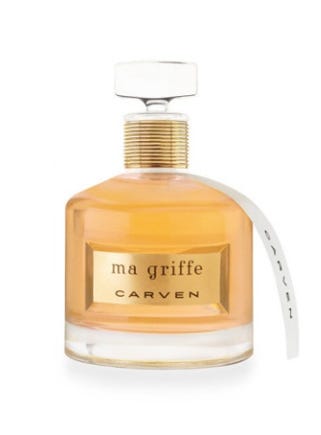
As soon as she announces the title of her poem, Busck-Nielsen undermines it, immediately dropping us into both the middle of a conversation and the shifting sands of a dysfunctional relationship where the speaker deals with the ultimate unreliable narrator: a parent living with addiction. We are never told in the poem what “ma griffe” actually means, though it becomes clear that it is a perfume with a “woody, balsamic note”. Mistranslation aside, it already has a double meaning: ““my signature”, but also “my talon”” (Vosnaki); not “My grief”. In the very first stanza, we are dealing with lies, hidden truths and complicated feelings, with the speaker themselves flipping between adult and child perspectives:
“My grief” came your quick reply. Without any French
but a sniff at English, you mistranslated brilliantly
and ‘Ma Griffe’ was the closest I got to you.
I long for its woody, balsamic note.
(1-4).
That the mother’s response is both “quick” and wrong raises a red flag. Her fast answer, also encoded in the sharp ‘i’ [ɪ] vowel sound of the dismissive “sniff” (2) already feels less about attentiveness and more about batting away a child’s enquiry. She is a speaker of neither French nor English, but her quick wit and disregard for accuracy give her the ability to improvise; something the now-adult speaker can’t help but admire: “you mistranslated brilliantly”. These two enjambed lines, however, end in poignancy with the end-stopped third line: “and ‘Ma Griffe’ was the closest I got to you.”. It is impossible to build intimacy with someone who can’t be trusted; the mother’s perfume ends up as a surrogate comfort, but her ‘signature’ scent is also her ‘talon’, and we are already wary of whether she will lash out even as we are kept at claw’s length. That she herself mistranslates it as ‘grief’ feels like a Freudian slip, revealing her feelings about her life and possibly also motherhood.

In one short quatrain, Busck-Nielsen has established a lacking relationship and the intense yearning it generates in the speaker, along with a rich sensory landscape which intensifies in the second stanza:
Your scent criss-crossed my childhood –
acrid stocking-toes out of stilettos, cigarettes, boiled coffee
the sweet whiff off your Mary Quant black and silver daisy box
and that fragrant scale of Dubonnet to Aquavit –
(5-8).
Now the mother’s “scent” is like a spoor the lonely child is tracking; or conversely like something that pursues them as it “criss-crossed my childhood” (5). There follows a list of smells in two long, enjambed lines parenthesised between dashes. Some are pleasant – “the sweet whiff off your Mary Quant black and silver daisy box” (7) gets a line to itself – others less so: “acrid stocking-toes out of stilettos, cigarettes, boiled coffee” (6); and the stanza ends with something more concerning; not a perfume a child should be able to recognise, and certainly not in such detail: “that fragrant scale of Dubonnet to Aquavit –” (8).
The euphony of repeated ‘a’ [eɪ] vowel sounds lulls us into a false sense of security, but as the second stanza plunges into the third with a run-on sentence, paused only by a dash to let us take in the significance of “Aquavit”, we realise that the “scale” referred to is less about scent than using weather as a metaphor for this unpredictable relationship in an adapted Beaufort Scale:
Dubonnet on your breath: good to fair.
Chardonnay: breezy. Carlsberg: heavy showers.
Aalborg Aquavit: severe weather warning –
for this I kept a torch and Donald Duck weeklies under my bed.
(9-12).
The light touch, even humour, of these lines belie the fact that they are describing a child so attuned to their mother’s alcohol consumption and attendant moods that they have become a meteorologist of alcoholism. The relative strengths and side-effects of the drinks listed translates to climatic conditions; Dubonnet keeps the mood, and the child’s experience, “good to fair” (9), and Chardonnay is similarly “breezy” (10); but the “heavy showers” (10) occasioned by Carlsberg imply tears. Things are at their stormiest when the child’s overly-sensitised nose detects “Aalborg Aquavit: severe weather warning –” (11). This Danish liqueur has a 40% ABV, and “for this I kept a torch and Donald Duck weeklies under my bed.” (12). The tone is plain, clinical, leaving us to do our own emotional work in realising the pathos of a child’s being so familiar with this situation that they have a response prepared to keep themself safe. There is no mention of physical needs being met, no food or drink hidden under the bed; instead, the speaker retreats to the escapist world of comics, and we realise just how young they must be.

Here we reach the volta in this almost-sonnet. Although the poem is narrated in the past, placing us firmly in the territory of recollection, its sensory language, whether nouns – “scent” (5), “whiff” (7) – or adjectives – “woody, balsamic” (4), “acrid” (6) – has made things feel immediate, evoking the oppressiveness of living in this fug of alcohol and temper, down to the claustrophobia of hiding under the bed. In the fourth and final stanza, we take a step backwards, achieving space with the speaker’s recognition of what was going on: “Bottles were translucent gods. Deluded cocky gods.” (13). We don’t need to be told that these are bottles of alcohol rather than perfume.
The phrase “translucent gods” does a lot of work here, simultaneously describing the physical glass and the metaphorical fragility of both the mother’s relationship with alcohol and with her own child. That this child, now an adult, has come to understand exactly what was going on is also signalled; with hindsight, the situation is as “translucent” as the bottles. The secrecy so often inherent in addiction is revealed: these “cocky gods” worshipped by the mother, and her arrogance in thinking she could hide her behaviour, are debunked as “deluded” without even the dignity of a comma, the swagger of the rollicking ‘o’ [ɒ] vowel sounds adding to the bathos.

In folklore, power may often be gained over something by naming it (Wikipedia). Here the speaker, now grown, takes control of their narrative through their hard-won lived experience:
My sense of smell is highly educated –
it hunts you down even now, the way the past turns up
in funny places – can pick you out in any crowd.
(13-15).
This knowledge, however, is a double-edged sword. If trauma sets cortisol levels artificially high in childhood, it can have a lifelong impact (Keener); something embodied in the phrase “it hunts you down even now” (14). The speaker is haunted by their childhood just as much as their ever-alert nose searches for the scent of their mother “in any crowd” (15); base notes of longing with top notes of fear. The speaker tries to brush this off conversationally: “the way the past turns up / in funny places” (14-15), but the expert break after “turns up” jars us just as much as any Proustian moment of sensory triggering (Fernyhough): what “turns up” may not be welcome. The speaker may keep things as “breezy” as their mother is on Chardonnay (10) by shrugging “But I digress.” (16), but a gut punch is coming.
The end-stopping of this line with a sharp, three-word sentence gives us a moment to prepare before it hits us with the devastatingly symbolic orphan line that ends the poem: “Your signature runs aldehydic in my veins. I must write it out.” (17). The speaker feels the epigenetics of being the child of an alcoholic, abusive parent; fears that trauma and addiction are now in their blood, as pervasive as alcohol or the aldehydes (Brown) – ironically derived from alcohol – which comprise perfumes. This is a ‘griffe’ – in the sense of “signature” rather than claw, emphasised here by italics – that the speaker wholeheartedly rejects, intending to exorcise it: “I must write it out.” (17). The poem ends as abruptly as it started, the readers abandoned like the child, but with a new scent on the air: that of survival.

*******
Something I like to do when reading poems is to see what poem is created by the end words, a kind of golden shovel in reverse. Here’s the end word poem from this piece, keeping any punctuation, with one line per stanza. As ever, putting the end words together highlights the movement of the poem: the glamour of the first stanza shifting to unease in the second – “childhood” and “Aquavit” being a particularly uncomfortable juxtaposition – to the menacing metaphor of unpredictable weather in the third.
French brilliantly you. note.
childhood – coffee box Aquavit –
fair. showers. warning – bed.
gods. educated – up digress.
out.
*******
Each week, I’ll share a poem of my own if I think I’ve one which chimes with the poem under discussion. Here’s “Adagio”, which was highly commended by Pascale Petit in the 2025 Plough Poetry Prize.
Content note: bereavement
Adagio

Better to skate quickly over thin ice
than sit with loss, though it sits with me,
hand on my neck. I keep moving,

think I can twitch my skin away
from its fingers, defy a hurt
I won’t dignify with denial

but won’t acknowledge either –
until I’m in an eighteenth-century church
and they play Adagio for Strings.

I rage against the planned beauty:
the soft blue of the stained glass,
the candles. My grief

is on my terms. Watch.
I drop to my knees hard,
begin to dig, hands gouging,

nails splintering on glaze,
ceramic, cement, stone,
pitch forwards, strike my chin,

bite my tongue. Taste blood,
grit against my gums. Teeth
shatter as I gnaw through London clay,

chalk, firestone, down to magma
blistering my lips, scorching my throat
as I scrabble, sob, burrow

to my red-hot iron core,
burn without consuming.
Is this what you wanted?

Suzanna Fitzpatrick

Works Cited
Brown, William H. “aldehyde.” Britannica, 14 May 2026, www.britannica.com/science/aldehyde. Accessed 27 May 2026.
Fernyhough, Charles. “The madeleine moment.” Pieces of Light, 16 January 2011, charlesfernyhough.com/2011/01/16/the-madeleine-moment/. Accessed 27 May 2026.
Keener, Amanda B. “Unseen Scars of Childhood Trauma.” BrainFacts, 22 April 2021,
www.brainfacts.org/diseases-and-disorders/mental-health/2021/unseen-scars-of-childhood-trauma-042221. Accessed 27 May 2026.
Master of Malt. “Aalborg Jubiläums Akvavit.” Master of Malt, www.masterofmalt.com/. Accessed 27 May 2026.
Met Office. “Beaufort wind force scale.” Met Office, weather.metoffice.gov.uk/guides/coast-and-sea/beaufort-scale. Accessed 27 May 2026.
Vosnaki, Elena. “Caught In Her Clutches – Ma Griffe by Carven: fragrance review.” Perfume Shrine, 28 May 2008, perfumeshrine.blogspot.com/2008/05/caught-in-her-clutches.html. Accessed 27 May 2026.
Wikipedia. “True name.” Wikipedia, en.wikipedia.org/wiki/True_name. Accessed 27 May 2026.
Thank you Suzanna for this poem and your close read. Line 12, “I kept a torch and Donald Duck” hit me too, and it is the tone being plain and clinical leaving “us to do the emotional work”. I also enjoyed re reading your poem Adagio, how bereavement sits “hand on my neck”, so true!
The vowel sound analysis is so good. Excellent piece.