The Deeper Read 22
Jill Abram

“Many Happy Returns” from Forgetting My Father (Broken Sleep Books, 2023).
Jill’s website is here.

Content note: dementia
Format note: both columns are meant to be left-justified, but it looks from the previews that this formatting may not translate well when viewed on different devices, and I can’t seem to fix it. Apologies to Jill!
Many Happy Returns

Where’s my brother?			He’s in South Africa.
So what’s this place?			Eventhal House.
Who lives here?				You live here, Dad.
Who are you?				I’m your daughter.
Who’s your mother?			She is.
Does she live here?			No, she lives in Gatley.
So what’s this place?			Eventhal House.
Where’s that?				Manchester.
Manchester?				        Yes, Manchester.
Who are you?				I’m your daughter.
Where do you live?			London.
London?				        Yes, London.
Why are you here?			To visit you.
What are we doing?			Celebrating your birthday.
Is it my birthday?			        Yes.
How old am I?				87.
87?					                Yes.
I’m 87?					        Yes, Happy Birthday!
I’m 87! I’d better sit down.

Jill Abram

The title chosen by Abram for this poem is deceptively simple and does a huge amount of heavy lifting; I’d go so far as to say it is structural in its scope. It appears to be what I call a ‘Ronseal’ title (does what it says on the tin): this is a poem about a birthday. However, it is not called “Happy Birthday” or “On a Birthday” or even “Birthday”. Abram is deliberately using an archaic form of birthday greeting, dating back to the Eighteenth Century and not much used these days (Martin). This hints that the person being addressed is older, and it transpires in the poem that they are the speaker’s elderly father.
There is also a growing feeling of cognitive dissonance in the sense that the adult daughter can’t cope with many more ‘returns’ of this situation; whether yet another question to answer, another depleting visit, or even another birthday in a life that has lost much of its quality through physical and mental decline; yet at the same time she fears the time when such ‘returns’ will stop with death. Certainly, nobody present appears to be happy. Abram’s skill is in holding this tension and embodying it in the poem’s form: a call and response between daughter and father which becomes increasingly heartrending as the poem progresses in two columns down the page.

I can never resist reading a column poem both across and down and am impressed if it makes sense both ways; poems that manage this always increase their emotional scope. If we read this poem straight across, we experience the rhythmic and rather relentless back-and-forth of a circular conversation as we’re an omniscient observer. If we read the first column, we focus on the elderly father’s point of view: bewildered, desperately trying to orientate himself in time and space in a world which no longer makes sense to him. When we read the second column, our sympathies switch to the parentified daughter explaining the same things over and over, her answers becoming shorter as she runs out of energy. This is a form which enables Abram to deliver three perspectives simultaneously: no meant feat.
I’m always interested when a poet deploys anaphora (Poetry Foundation). As Maxwell observes: “Recurrence of words isn’t repetition. Ever.”, noting of Frost’s famous refrain “And miles to go before I sleep”: “What’s intervened between the two technically identical lines is the need to say the same again. Either side of that are different worlds.” (45). In poetry about dementia of whatever type (other poems in the book movingly explore how Abram’s father suffered a devastating stroke), repetition becomes both form and theme, as in my poem “Metacat”, shared at the end of this post. Of the 19 lines spoken by the father, 10 – more than half – begin with interrogative words: “Where” (1, 8, 11); “Who” or “Who’s” (3, 4, 5, 10); “Why” (13) “What” (14), “How” (16). The sentences are extremely short; one clause and sometimes only one word, and most words are monosyllabic; the few that aren’t being either nouns for family members (names having been forgotten) or place names. The cumulative sense is of a speaker too mentally and physically depleted to say more.

It has been observed in dementia research that: “As the brain changes, the areas responsible for memory, reasoning, and social interpretation begin to misfire. The person loses track of what happened, when, or why, and the mind fills in the blanks with stories that feel emotionally true, even if they’re not factually accurate. It’s not “being difficult.” It’s the brain’s attempt to make sense of a world that’s becoming disorienting. When memory fails, emotion steps in as the narrator.” (Wood). Appropriately, Abram’s use of repetition is multifaceted in the way that she structures it into emotional strands, giving an insight into the father’s perspective. The majority of the first five lines are about people:
Where’s my brother?			He’s in South Africa.
So what’s this place?			Eventhal House.
Who lives here?				You live here, Dad.
Who are you?				I’m your daughter.
Who’s your mother?			She is.
(1-5)
He begins, touchingly, by asking for someone who can’t be there, and we feel the daughter’s pang that this is at the forefront of his mind rather than her. He then seeks reassurance as to everyone’s identity, including his own: “Who lives here? You live here, Dad. / Who are you? I’m your daughter. / Who’s your mother? She is.” Abram’s sequencing of these questions and her use of the family nouns is deft. They are ostensibly orientation for the speaker’s father, but they also quickly establish the relationships for the reader and show us the extent of the father’s cognitive challenges. He is no longer able to recognise his wife and child, asking who his daughter is even after she has called him “Dad”, and unsure of where he is; but poignantly he still begins by trying to understand people over everything else.
His desire to understand his interpersonal relationships threads through the poem, even after he moves on to trying to establish location:
Does she live here?			No, she lives in Gatley.
So what’s this place?			Eventhal House.
Where’s that?				Manchester.
Manchester?				        Yes, Manchester.
Who are you?				I’m your daughter.
Where do you live?			London.
London?				        Yes, London.
(6-12)
We can sense his confusion as four different locations are mentioned (five if we count South Africa in the first line). With a very light touch, Abram makes us realise just how complicated life is, especially in the modern age of fast travel and faster technology; really, it’s amazing how our brains store all the information they do, and unsurprising how much havoc a trauma such as a stroke can wreak. “Manchester” is mentioned three times (8-9), as is London (11-12), the call and response of these cities going from daughter to father and back again; he repeating whatever she says as questions, she wearily reaffirming the answers; her exhaustion doubtless intensified by all the travelling she is doing. We begin to get the sense that their entire relationship is now defined by him asking and her answering, as if no other type of exchange is now possible. The father of whom Abram says in another poem “I have forgotten he could perform miracles;” (“I Have Forgotten My Father”, 1), who gave so much to her, is now only capable of taking. He repeatedly needs her to define herself in relation to him, asking “Who are you?” in lines 4 and 10, near the start and at the centre of the poem. We feel for her: it is as if no other identity is permitted to her, and even this is shaky.

Having interrogated location, the father moves on to events:
Why are you here?			To visit you.
What are we doing?			Celebrating your birthday.
Is it my birthday?			        Yes.
How old am I?				87.
87?					                Yes.
I’m 87?					        Yes, Happy Birthday!
I’m 87! I’d better sit down.
(13-19)
Now the refrain is “birthday” (14, 15, 18). Its repetition is sadly reminiscent of an excited child telling everyone it’s their big day; except in this case the reason for the refrain is the father’s inability to comprehend what this means. He does, however, remember that this word usually goes hand in hand with a tally of age, and his question “How old am I?” (16) sparks another tautological chain reaction with “87” reiterated in each of the poem’s final four lines (16, 16, 18, 19). Along with his daughter, we are painfully aware that, at 87 and in obvious ill health, there may not be many birthdays left to ‘return’ to him.

At the poem’s end, the relentless end-stopping that punctuates this never-ending conversation switches from question marks and full stops to exclamation marks. In tune with the cognitive dissonance of the poem, these are ambivalent: the daughter’s “Happy birthday!” may contain a stab of anger and sadness within its apparent cheerfulness, and the father’s response – “I’m 87!” – may betray disbelief as well as glee. Startled out of his cycle of questions, his final statement is, intentionally or not, humorous: “I’d better sit down.” (19); we do not know whether he is already sitting down. There is no response at all from his daughter this time: she is worn out. The second column is abruptly cut short on her side, and we are painfully aware through this that it’s the first column, the father’s, that is already crumbling and soon to end.
Abram has told me that she often chooses to close a set by reading this poem, and I can see why. It’s a great performance piece, witty and moving, and unsentimentally says something deeply moving about the nature of life and love, ageing and loss. These are topics in which I have a particular interest, having covered them in my book Crippled from the point of view of my mother’s chronic illness with Multiple Sclerosis, her death and the grieving process Greg Freeman wrote that I experiment “with different forms and formats, but the urgency of her language is unconcerned with imagery or metaphor. Perhaps some subjects are too big to require such additions”. I feel the same is true of Abram in this poem.
*******
Something I like to do when reading poems is to see what poem is created by the end words, a kind of golden shovel in reverse. Here’s the end word poem from this piece, keeping any punctuation, and all in one block as per the original poem. Because this is a column poem which can be read both across and down, I’m including two columns of end words. Doing this really brings out the devastating effect Abram creates with her use of repetition. In the first column, every line bar the last is end-stopped with a question mark, which quickly becomes tiring to read and conveys the strain of dealing with a constant stream of questions; the added poignancy being that these are not from a curious child but from the stroke-damaged mind of a parent trying but unable to comprehend their situation. In the second column, every line apart from the last is end-stopped with a tired full stop as the adult daughter gives the same responses over and over. There are also some wistful juxtapositions in the second column’s end words, most notably “Dad.” (3) and “daughter.” (4).
brother?			        Africa.
place?				House.
here?				Dad.
you?				daughter.
mother?			        is.
here?				Gatley.
place?				House.
that?				Manchester.
Manchester?			Manchester.
you?				daughter.
live?				London.
London?			London.
here?				you.
doing?				birthday.
birthday?			Yes.
I?				        87.
87?				        Yes.
87?				        Birthday!
down.
*******
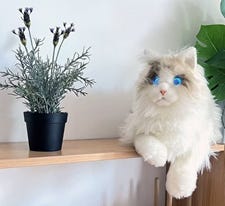
Each week, I’ll share a poem of my own if I think I’ve one which chimes with the poem under discussion. Here’s “Metacat”, first published in Fulcrum Review Issue 3 “Glitched Narratives”, edited by David Wong. It’s a form I’ve evolved and call a disintegrated triolet, keeping the trapped feeling of a traditional triolet’s repetition but breaking it down to give a sense of something malfunctioning within a framework: the end words are unchanged, but the rest of each line’s syntax alters, subtly leaching sense from what is said.
Content note: dementia
Metacat

a disintegrating triolet

Metacat, Metacat, are you awake?
Metacat, Metacat, time for bed.
Metacat, there are pills to take.
Metacat, Metacat, are you awake?
Metacat, can you hear me? Shake
your head for no. Nod for yes.
Metacat, Metacat, are you awake?
Metacat, Metacat, time for bed.

Metacat, are you Metacat? Awake.
Time, Metacat, for Metacat bed.
There are Metacat pills to take.
Metacat, are you Metacat? Awake.
Hear me, Metacat! Can you shake
for no, for yes? Nod your head.
Metacat, are you Metacat? Awake.
Time, Metacat, for Metacat bed.

You, Metacat, are Metacat. Awake
time for Metacat. Metacat, bed.
Pills, Metacat, are there to take.
You, Metacat, are Metacat. Awake.
Metacat, can you hear me shake
head for your nod? No for yes.
You, Metacat, are Metacat. Awake
time for Metacat. Metacat, bed.

Suzanna Fitzpatrick

“Behavioral problems may affect individuals with dementia, increasing the cost and burden of care. Pet therapy has been known to be emotionally beneficial for many years. Robotic pets have been shown to have similar positive effects” – Petersen, Sandra et al. “The Utilization of Robotic Pets in Dementia Care.” Journal of Alzheimer’s disease: JAD vol. 55,2 (2017).

“Her empty lap deserves a warm heartbeat”. – chongker.com, manufacturers of Metacat
Further information and support:
Works Cited
Fitzpatrick, Suzanna. Crippled. Red Squirrel Press, 2025.
Freeman, Greg. “Unflinching poet Suzanna Fitzpatrick maps loss and grief.” Write Out Loud, 3 July 2025, www.writeoutloud.net/public/blogentry.php?blogentryid=142377. Accessed 2 June 2026.
Martin, Gary. “Many happy returns.” Phrase Finder, www.phrases.org.uk/meanings/many-happy-returns.html. Accessed 2 June 2026.
Maxwell, Glyn. On Poetry. Oberon Books Ltd., 2016.
Petersen, Sandra et al. “The Utilization of Robotic Pets in Dementia Care.” Journal of Alzheimer’s disease: JAD vol. 55,2 (2017).
Poetry Foundation. “Anaphora.” Poetry Foundation, www.poetryfoundation.org/education/glossary/anaphora. Accessed 2 June 2026.
Wood, Kristie. “When a Loved One With Dementia Becomes Paranoid.” Psychology Today, 14 November 2025, www.psychologytoday.com/gb/blog/connection-and-coping/202511/when-a-loved-one-with-dementia-becomes-paranoid. Accessed 2 June 2026.