The Deeper Read 25
P. A. Erskine

“This Business of Size”, winner of the Verve Poem of the Month, October 2025.
Also featured as a prompt on day 218 of Georgia Conlon’s excellent 365-day Writing Poetry Challenge Instagram series, well worth checking out.
P. A. Erskine is on Instagram: @salycylic_
This Business of Size

I became so small once I was as small as the pages
I started essays on and crumpled up, crumpled up
so by the end of the night the floor was littered
with clenched fists of paper. I looked all the time like a girl
but all the time I was pieces of paper. I still rode my bike
to the market or to lectures, in a red knitted cape,
or in a blue denim jacket, and I looked like a girl
but the whole time I was paper and unfinished sentences
or a silver pill box with a green stone in the lid
very hard to open and the whole of my head
was inside it. I looked like a girl and could see leaves
turning yellow and the mist drifting up from the river
but all that time I was trying to find where
my mind was and where was everyone else?

P. A. Erskine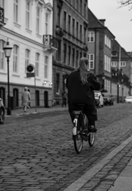
The title of Erskine’s poem is both cryptic and conversational. Her use of “This” rather than ‘the’ is important: its immediately arresting assonance of the ‘ɪ’ vowel sound sets the tone for her sound-play, and its intimacy draws us in. We sense that we are about to be told a story, and the eerie fairy-tale-adjacent narrative which ensues does not disappoint. We also notice the length: fourteen lines. It’s not a conventional sonnet, but it’s nonetheless a love poem to selfhood. The lines are longer than usual, ranging from ten to sixteen syllables, with five lines being fourteen syllables. This intensifies the sense of what Paterson refers to as the sonnet’s “box [of] dreams” (Paterson xxiv), creating a squarer shape on the page and echoing the “silver pill box” image in line 9.
Erskine is skilled at owning the narration of a poem, in particular voicing those denied such agency in their original stories; I highly recommend hearing her perform her poems written from the perspective of her namesake Penelope in The Odyssey. Her opening line references the ‘once upon a time’ of fairy tales but begins firmly with “I” and repeats the first-person pronoun within the same line; in fact, this appears ten times during the poem in over half the lines, with “my” occurring twice. We immediately get the impression of a strong speaker, but one who is struggling; ironically, this strong sense of self is fragmented by dissociation:
I became so small once I was as small as the page
I started essays on and crumpled up, crumpled up
so by the end of the night the floor was littered
with clenched fists of paper.
(1-4).

The breathless enjambment of the first three lines hurtles us into the fourth, where we are brought up short with a caesura. From the past simple conjugation of the verbs, we know we are in the speaker’s personal history – from “essays” (2) we assume university; from “leaves / turning yellow “ (11-12) we deduce the autumn term – but things feel very immediate and claustrophobic. The omission of punctuation in the opening line makes it what I think of as a ‘Venn diagram’ line, pivoting on the story-like “once”. The speaker tells us that she “became so small once” at the same time as asserting “once I was as small as the pages”. This interlocking of syntax and repetition adds to the claustrophobia, as do the rocking anapaests (dee dee DUM) of “crumpled up, crumpled up” (2). The tunnel vision obsessiveness of what we used to call an ‘essay crisis’ in my Oxford days is gut-churningly evoked, culminating in the visceral image of “clenched fists of paper” (4), embodying tension and frustration.

The speaker is metaphorically shrinking under pressure just as the floor is vanishing under her rejected attempts, and as the poem progresses she vanishes entirely into the paper metaphor: “I looked all the time like a girl / but all the time I was pieces of paper.” (5). As well as the adjacent “pages” and “essays”, the word “paper” appears three times in the first half of the poem as the speaker’s identity is invaded by her studies. She admits “I looked all the time like a girl”, and even describes herself in concrete terms, wearing vivid clothes and doing what we’d expect a student to be doing, reiterating her girl-ness three lines later:
                                                                   I still rode my bike
to the market or to lectures, in a red knitted cape,
or in a blue denim jacket, and I looked like a girl
(5-7).
However, this apparent normality is subtly undermined. The only end-stop in the whole poem, bar the ending, makes us pause with a comma after “red knitted cape,” and consider Red Riding Hood, going through the motions of the task she has been set but lost in unfamiliar terrain and pursued by a predator. Here we begin to suspect the predator is some form of mental breakdown, as the speaker then runs on from the protesting-too-much reassertion of “I looked like a girl” straight into a succession of metaphors for how she really felt:
but the whole time I was paper and unfinished sentences
or a silver pill box with a green stone in the lid
very hard to open and the whole of my head
was inside it.
(8-11).
This is the volta of the sonnet. The paper image is reiterated and developed, the earlier discarded drafts becoming the “unfinished sentences” of which the speaker now feels she is comprised in her volatile, half-written state. Her whole identity is simultaneously in flux and imprisoned in the “silver pill box with a green stone in the lid / very hard to open” (9-10). The description of the pill box, both forensic and surreal, with its intimations of medication and ill health, is rendered all the more chilling in its beauty for being “hard to open”. We are unsure whether the speaker can get what she needs from it; or indeed whether she can escape it, given that “the whole of my head / was inside it.” (10-11).

This searing evocation of the feeling of being imprisoned in an ostensibly ordinary but increasingly menacing Groundhog Day has been steadily built up by Erskine through repetition, each time with a subtle change so that we almost don’t notice it until it’s too late: the recurring paper imagery, sonically conjured with understated sibilance – “small” (1), “pages” (1) “started essays” (2), “fists” (4), “pieces” (5); the shifting from “all the time” (4, 5) to “the whole time” (8); the way in which “I looked all the time like a girl” (4) morphs into “I looked like a girl” (7, 11). The speaker has become her own unreliable narrator, and the final four lines of the poem complete her dissociation. She has already described herself but not actually described herself; in a clinical tone, detached from her inner reality. Now she details her surroundings as dispassionately, creating a sense of disjunction between herself and the world she can sense but is unable to feel a part of:
                        I looked like a girl and could see leaves
turning yellow and the mist drifting up from the river
but all that time I was trying to find where
my mind was and where was everyone else?
(11-14).
We can see the memento mori of the autumn leaves and feel the chill of the river mist, but the speaker herself is detached from them. The time refrain evolves again to “all that time”, deepening the feeling of being caught in a loop and lending an unbearable pathos to the use of “once” in the first line. The speaker’s obsessive quest is not just for the right words for her essay but for her very identity, constantly “trying to find where / my mind was” (13-14) and wondering, as we all do at some point, whether everyone else has it together: “and where was everyone else?” (14).

The irony is that, as she herself appears to be ‘there’ but doesn’t feel it, it’s entirely possible that at least some others feel the same, but at that age the speaker lacks the life experience to appreciate this. Ending the poem on a question leaves its tortuous convolution running in a manner reminiscent of M. C. Esher’s “Relativity”, trapping us with the speaker in her distressed mental state. This is Erskine’s dexterity with storytelling: we know we are in the past, that all this is over, and that presumably the speaker survived in order to be able to tell us about it now; yet we are denied the consolation of hindsight. Ruthless: but as a portrayal of mental distress in early adulthood, grimly compelling. The speaker can neither find herself nor relate to anyone else, and now the full meaning of the title is revealed. It is about feeling secure enough to take up space in the world as one’s full self; something not encouraged for any of us by the real-life ‘business’ of patriarchal capitalism, least of all for girls.
*******
Something I like to do when reading poems is to see what poem is created by the end words, a kind of golden shovel in reverse. Here’s the end word poem from this piece, keeping any punctuation, and all in one block as per the original poem. The use of enjambment in speeding us headlong through the poem is immediately apparent, as is the use of repetition with “girl” (4, 7). The slant rhyme of “lid” and “head” (9, 10) uneasily shackles these two images, creating a third more violent image of a lid closing onto the speaker’s head; and the juxtaposition of “where” and “else?” (13, 14) in the final couplet rounds the poem off with a fitting poignancy.
pages
up
littered
girl
bike
cape,
girl
sentences
lid
head
leaves
river
where
else?
Each week, I’ll share a poem of my own if I think I’ve one which chimes with the poem under discussion. Here’s “Punting Through Ice”, which was first published in Poetry News Autumn 2025, selected by Helen Farish for Members’ Poems on the theme of ‘Clearing’. It was written in a response to a photograph by Erica Longfellow and displayed in her 2025 Oxford Inverted exhibition at Pembroke College JCR Art Gallery, part of the Oxford Festival of the Arts, which is running this year until 30 July 2026.
Punting Through Ice

It takes a while to realise
you’re living in monochrome –
a creeping frost inside windows
as the heating fails. Some things
only work in colour: summers,
love. I remember going punting
with a boyfriend – it was June
but cold, rain dispersing picnics,
diluting Pimm’s. I’m at the pole
and we’ve just gone past a bridge
when it pours. He shouts at me
to get back under it, shelter him –
but reversing a lidless coffin
wearing sandals and a boho dress
was never going to work. My feet
slip from under me on the rain’s ice.
There’s black water, white bubbles.
I kick hard, break the surface,
blink silted eyes. His back is turned,
looking for me on the wrong side.

Suzanna Fitzpatrick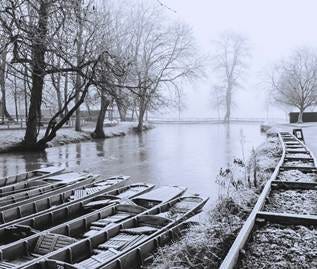
Photo: Erica Longfellow
Works Cited
Escher, M. C. Relativity. 1953, Escher in Het Paleis, Den Haag. Lithograph, 27.7 x 29.2 cm. Escher in Het Paleis, escherinhetpaleis.nl/en/about-escher/masterpieces/relativity. Accessed 23 June 2026.
IMDB. “Groundhog Day.” IMDB, www.imdb.com/title/tt0107048/. Accessed 23 June 2026.
Paterson, Don. “Introduction.” 101 Sonnets, edited by Don Paterson, Faber & Faber, 1999, pp. ix-xxiv.
Feel as blown away by this beautifully attentive analysis as I was by winning the PoM. Thank you so much 🙏😘
Between the two poems, you’ve powerfully evoked some of the hardest things about leaving home for the first time and going to university: navigating the world of dating, and grappling with the relentless academic pressure. I really enjoyed and identified with both of them. And I think the exercise of looking at end-words yields even more fruit than usual on this occasion due to the fantastic line-breaks. Especially that final “who else"?”