The Deeper Read 27
Rishi Dastidar

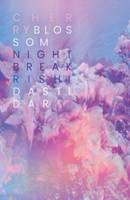
“How to verb a sore heart” from Cherry Blossom at Nightbreak (Nine Arches Press, 2026).
Poetry Book of the Month, The Observer, March 2026
Best recent poetry - review roundup, The Guardian.
Rishi’s website is here.
How to verb a sore heart
for Helena

because truthfully, I don’t know the correct
verb to use right now. Is it ease? But then
does your heart need rest, or a reset? Is it heal?
But then fracture is good for becoming stronger –
this is what the medicinal songs tell me.
It could be google or pop or sublimate,
but then I am prescribing information,
champagne and revelations, and while that
is a trinity to savour it could make you horizontal
instead of vertical again. Write this scrip,
soften with the last tear and inhale the mâché:
know there is always someone breathing with you,
whatever the hour, leaning your way like a sun
escaping gravity just because you wished it to.

Rishi Dastidar

Reading Cherry Blossom at Nightbreak, it occurs to me that, as with a sonnet, there’s a volta around two-thirds of the way through the collection. The tone throughout is philosophical but playful, wearing its deep thinking lightly, but a shift occurs as many of the later pieces in the collection meditate on the loss of love. This poem is no exception, though here the speaker attempts to offer comfort to the dedicatee rather than exploring their own experience, and it isn’t clear whether their friend is enduring a relationship break-up or something else; other kinds of heartbreak being available.
This uncertainty is present in the poem from the very start: in its form – fourteen lines, but neither one of the classic sonnet schema nor a traditional love poem – and in its title. How to what a sore heart? We are immediately intrigued, drawn in by both the mystery and the way in which the drop-in title takes us straight into the first line, the speaker explaining: “because truthfully, I don’t know the correct / verb to use right now.” (1-2). This narrator is conversational and disarmingly frank: the opposite of unreliable in that they are telling us they are at a loss for words. We believe that they are speaking “truthfully” because we can immediately identify with the situation that Dastidar conjures with just the title, the dedication and the opening sentence: we have all been wordless in the face of a friend’s pain, wanting to help but unsure how. In such a situation, there is no “correct” thing to say, and Dastidar’s deft line break implies this, as does the sudden halt of the poem’s opening flow with a caesura in the second line.

The latter also offers hope, coming as it does after “right now”. The colloquial tone of this phrase continues to draw us in, but also serves as a reminder that all experiences, no matter how challenging, are time-bound. The speaker can’t find the word they need “right now”, but they will do, and indeed they start trying:
                                       Is it ease? But then
does your heart need rest, or a reset? Is it heal?
But then fracture is good for becoming stronger –
this is what the medicinal songs tell me.
(2-5).
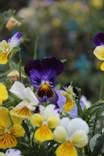
The process of searching for the apposite word is back and forth, much like the process of healing. The word “ease?” is immediately undermined with a question mark caesura and a line break after “But then” as the speaker considers whether the addressee’s heart most needs “rest, or a reset?”. The pun is worthy of a Shakespearean sonnet, and the reference to heartsease also takes us back to Tudor times, medicinal herbs and the symbolism of flowers (Hickey). Another word – “heal?” – is suggested and again dismissed, this time with a question mark and a line break, and with its assonant echoing of the already-discredited “ease?”. Maxwell notes how vowels are the air in a poem and Dastidar makes full use of them, embodying the sounds of suffering in the poem with their gasps and groans: even the title moves rapidly through six vowel sounds. The speaker’s self-doubt continues with the repetition of “But then” in line 4 and intensifies to humorous bathos: “But then fracture is good for becoming stronger – / this is what the medicinal songs tell me.” (4-5).
So far, we have trusted the speaker because they have been clear about their unreliability, but now we laugh and have our own doubts. Is fracture good for “becoming stronger”? Not in the case of bones, certainly, despite the myths. However, we are emotionally re-engaged with the poignant reference to “medicinal songs”; who hasn’t soothed distress by listening to “the food of love” (Shakespeare, Twelfth Night I:I 1)? Dastidar often references songs in this collection, most notably in “The folded-up carousel” and “Melted cockerel”. I’m not sure whether a specific heartbreak song is intended here but was certainly thinking of Kelly Clarkson’s “Stronger (What Doesn’t Kill You)”, which had pride of place on my marathon playlist until it turned out that what doesn’t kill you can nonetheless erode your cartilage and lead to surgery.
When I was still running, I often came across pacers in races: volunteers who are so experienced that they can maintain a specific pace per mile and help others aiming for particular race times. I was reminded of this by Dastidar’s own skilful pacing in the poem, allowing us to take in the multiple levels at play: humour, emotion, even philosophy. As mentioned earlier, the title drops into a sentence which then ends in the middle of the second line and is followed by three short sentences in lines 2-3. Line 4 is a parsing line offering a complete thought (Longenbach 69), though slowed by the en dash at its end, then line 5 is another parsing line offering support for the premise of its predecessor.
At this point, the speaker’s imagination takes off in a sentence which runs from line 6 to the middle of line 10, but Dastidar continues to control the pace, slowing it by deploying more end-stopped parsing lines (6, 7) and caesurae (8, 10):
It could be google or pop or sublimate,
but then I am prescribing information,
champagne and revelations, and while that
is a trinity to savour it could make you horizontal
instead of vertical again.
(6-10).
In this mid-section of the poem, we feel wrong-footed by the speaker. We began admiring them for being up-front about not knowing what to say, and we stayed with them as they tried out different verbs for what action the addressee’s heart might need. Now they dispense with the italics, and for a moment we don’t realise that “google or pop or sublimate” are also suggested verbs which they are “prescribing” (7). They are suddenly confident, telling us that by these verbs they mean “information, / champagne and revelations,” (7-8), but our trust in them is eroded by the subtext of their brittle wittiness.
Googling something without real knowledge has always been high-risk, all more the so in the post-truth age of AI; and surely nobody wants their heart to “pop”. Self-medication with alcohol is a time-honoured way of dealing with pain – “alcohol applied internally for cardiac issues”, as my much-missed Oxford tutor Malcolm Parkes had it when I was a lovelorn student – but not a great long-term solution. The associations of “sublimate” aren’t reassuring either: in chemistry, it refers to passing from a solid to gas state without going through the liquid state (Britannica, “sublimination”), and in psychology to handling challenging feelings by pouring them into an outlet like sport or creativity; perhaps poetry (Britannica, “defense mechanism”). Either way, something is skipped, something is glossed over, and we suddenly wonder whether the speaker is a quack.

They come to the same conclusion, admitting that their proposed treatment plan, whilst sounding easy and indeed glamorous, might be the opposite of helpful: “while that / is a trinity to savour it could make you horizontal / instead of vertical again.” (8-10). Once again, their openness wins our trust. What, then, to do? At the slightly delayed volta of the poem, another example of Dastidar’s assured pacing, we are offered a suggestion:
                                            Write this scrip,
soften with the last tear and inhale the mâché:
know there is always someone breathing with you,
whatever the hour, leaning your way like a sun
escaping gravity just because you wished it to.
(10-14).
This is the final sentence of the poem, stretching across four-and-a-half lines, and suddenly the speaker’s previous doubt and surface wit melt into tender sincerity. All the hesitancy, the questions – “Is it” (2, 3) – the qualifiers – “But then” (2, 4, 7) – are swept away by imperatives. We are instructed: “Write this scrip,” (10), and suddenly we not only trust the speaker, who is using a medic’s term for a prescription, we also trust ourselves to know best what our own medicine should be, as they in turn trust us. The imperatives become incantatory as the suggestions, previously deliberately hackneyed, take flight into the magical: “soften with the last tear and inhale the mâché: / know there is always someone breathing with you,” (11-12).
The deceptively flippant suggestion of turning a prescription into papier mâché with tears is actually profound: cry as much as you need to, know that this is more helpful than any other advice which might be thrust at you. Above all, know that you are not alone: in a planet of around 8.3 billion humans (Wikipedia), someone else will understand how you feel. We suddenly realise that this “someone breathing with you” is the speaker, promising their friend that they are “leaning your way like a sun / escaping gravity just because you wished it to.” It is so natural to want to use magical thinking as a way of dealing with loss of any kind, and here the speaker encourages the addressee and us to lean into this, imagining a friendship so strong that it can challenge the laws of physics; conversely persuading us that whatever we’re going through is survivable.

*******
Something I like to do when reading poems is to see what poem is created by the end words, a kind of golden shovel in reverse. Here’s the end word poem from this piece, keeping any punctuation, and all in one block as per the original poem. What comes across is the doubt inherent in the early part of the poem, and how it skilfully hinges on “sublimate” around its midpoint (6) before confidently ending with lines which juxtapose the “you” being addressed (12) with the healing warmth of the “sun” (13).
correct then heal? stronger – me. sublimate, information, that horizonal scrip, mâché: you, sun to.
*******
Each week, I’ll share a poem of my own if I think I’ve one which chimes with the poem under discussion. Here’s “How to Preserve a Heart”, which was first published in The Waxed Lemon issue 7, edited by Joanne McCarthy and Derek Flynn.
How to Preserve a Heart

I have no instructions. Perhaps
a salt cure? Its integrity
survives repeated brining.

I shudder at pickling, flinch
from the sting of vinegar,
the suffocation of formaldehyde.

The freezer, at least, is temporary –
ice one, and it can be thawed,
though subtly changed.

I have seen one, dried wood-hard,
grated over an expensive dish
to add something. I think they said depth.

Suzanna Fitzpatrick

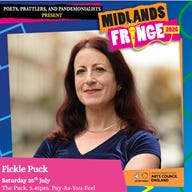
I’ll be performing my poetry burlesque show, Fickle Puck, at the Midlands Fringe Festival: Saturday 25 July 2026, 5.45pm, The Pack (Perfect Ale, Cask and Keg), 25-26 Queen Square, Mander Centre, Wolverhampton, WV1 1TQ. Just turn up, pay-as-you-feel. https://www.midlandsfringe.co.uk/shows/25thjuly2026.
Works Cited
Britannica Editors. “defense mechanism”. Encyclopedia Britannica, 24 April 2026, www.britannica.com/topic/defense-mechanism. Accessed 9 July 2026.
Britannica Editors. “sublimation”. Encyclopedia Britannica, 27 June 2026, www.britannica.com/science/sublimation-phase-change. Accessed 9 July 2026.
Clarkson, Kelly. “Stronger (What Doesn’t Kill You)”. Lyrics at Genius.com, genius.com/Kelly-clarkson-stronger-what-doesnt-kill-you-lyrics; performance at YouTube, 14 December 2011, youtu.be/Xn676-fLq7I?si=94VAhOR7kBcL3qNI. Accessed 9 July 2026.
Dayton Orthopaedic. “The Truth About Bone Fracture Healing: Myths vs. Facts.” Dayton Orthopaedic, daytonorthopedicsurgery.com/2023/05/16/fracture-healing/. Accessed 9 July 2026.
Hickey, Julia A. “Heartsease (viola tricolour) – Elizabeth I’s flower.” The History Jar, 24 March 2020,
thehistoryjar.com/2020/03/24/heartsease-viola-tricolour-elizabeth-is-flower/. Accessed 9 July 2026.
Longenbach, James. The Art of the Poetic Line, Graywolf Press, 2008.
Maxwell, Glyn. “Building Blocks of Form: Formal and Free.” Masterclass 1.8, 27 February 2024, The Poetry School. Seminar. Notes taken by me.
Shakespeare, William. “Twelfth Night.”. The Complete Works of William Shakespeare. OUP, 1994, pp. 691-794.
Wikipedia. “World population.” Wikipedia, en.wikipedia.org/wiki/World_population. Accessed 9 July 2026.