The Deeper Read 28
Wayne Holloway-Smith

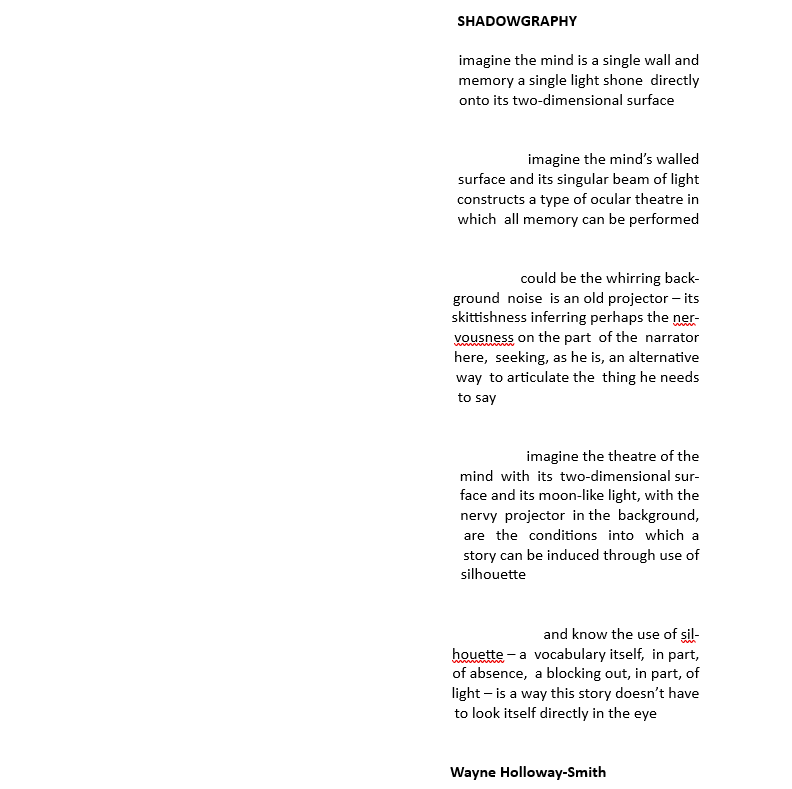
A section of “SHADOWGRAPHY” from RABBITBOX (Scribner Editions, Simon & Schuster, 2026).

Content note: this piece discusses child abuse, violence against women, alcoholism.
This is an excerpt from a book-length sequence: the line numbers given are purely relating to this excerpt for reference.
Holloway-Smith’s RABBITBOX is a book-length sequence, and I thought hard about whether The Deeper Read format can do justice to such a work. It’s one thing looking at a stand-alone poem from a pamphlet or collection, but another to curate a section from something intended to be read as a whole: in keeping with its breathless depiction of childhood trauma, there isn’t a single full stop. However, there are stanza breaks and colophons, and some sections have titles, often repeated, embodying a kind of PTSD flashback: “SHE” appears 18 times, weaving the dual figure of the speaker’s abused mother and imaginary friend/mother’s inner child avatar Alma (the Spanish word for ‘soul’) throughout the work.
“SHADOWGRAPHY” appears twice as a section title, and the excerpt here is five stanzas found on pp. 60-1 of the book. The book’s cover features hands forming the shadow of a rabbit; I was aware of the art of making shadows, but I didn’t know that a shadowgraph is used in physics: “Shadowgraph techniques utilize light and shadows to visualize patterns in fluid flows, shock waves, and transparent media for insights into density, temperature, and pressure changes.” Both definitions reveal something central to Holloway-Smith’s work. Narrating memory means dealing with shadows that flicker and change depending on what light the speaker chooses (or is able) to shed on them; the act of using the light and shadows of this narrative to express trauma can reveal shock waves that continue into the present day.

In a recent Poetry School seminar, Holloway-Smith said he felt there’s no such thing as a reliable narrator. Having an interest in narrating memory and trauma, I’m inclined to agree, but there are different types of unreliability. There’s the deliberate deceiver, entertaining or otherwise; I can’t resist Jeanette Winterson’s puckish fabulist, declaring with a wink “I’m telling you stories. Trust me” (13), signalling we should do anything but. There is also unreliable narration as self-protection; Joelle Taylor, for example, has said that, for her, ‘camp’ means saying the opposite of what is meant as a form of self-defence. The speaker in RABBITBOX is the latter type of defensive unreliable narrator, painfully aware of their own narrative fallibility: they know that there are places their mind cannot go, things they aren’t able to say.
This excerpt comes at the book’s midpoint. The scenario – a mother and young son trapped with an alcoholic abuser husband/father – has been viscerally established, and they are about to attempt an escape. The work undergoes a tonal shift, as if the speaker needs relief from the tension as much as the readers, and they suddenly reach out to us conversationally, breaking the fourth wall to talk about a wall: “imagine the mind is a single wall and / memory a single light shone directly / onto its two-dimensional surface” (1-3).
Embodying the fluid nature of memory, the text moves around the white space throughout the book: sometimes left-justified; sometimes centred; sometimes, as here, to the right. The speaker has their back against both an actual and a psychological wall inside claustrophobic stacking dolls of trauma: house, bedroom, cupboard, until we too are “a small body hidden / in the wardrobe” (p. 5). Now the speaker asks us to turn this wall into a metaphor: “Imagine the mind is a single wall” and consider the nature of memory: “a single light shone directly / onto its two-dimensional surface” (2-3). The starkness of the speaker’s physical surroundings and emotional situation becomes code for the starkness faced by anyone attempting to exorcize trauma: its very existence leaves them under-resourced to do so. The repetition of “single” brings home the limits of our one consciousness in trying to process something so huge; “two-dimensional” implying an inherent insufficiency, no matter how “directly” (emphasised by the line break) we focus our attention.
The next stanza also begins “imagine”, reminding us that this is really all we can do:

The speaker returns to their first image as they try to get a handle on what they are conveying, but with a change. We are no longer asked to “imagine the mind is a single wall” (1). Together with the speaker, we have made this mental leap, accepted the metaphor, and so moved on: “imagine the mind’s walled / surface”. These are deceptively simple images doing complex psychological work, attempting to pin down shifts in perspective. Here again is the reminder that memory is something the consciousness “constructs” as “a type of ocular theatre”. Our eyes may deceive us; as, in the words of Scrooge refusing to believe he can see the ghost of Marley, all our senses can: “a little thing affects them. A slight disorder of the stomach makes them cheats.” (59).
Is memory nothing more than a play which “can be performed”: passive, not active, with us as passive consumers of our own narratives?
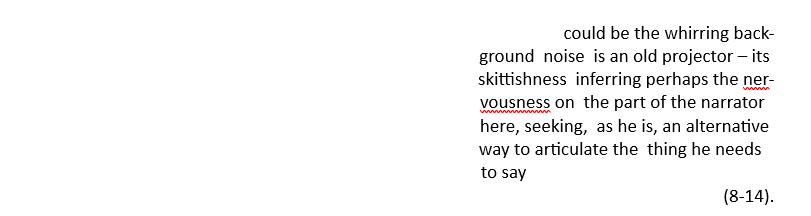
So far all has been the smoke and mirrors of light and shadow, but now sound intrudes in the “back- / ground”, the breaking of the word on the line enacting its sudden jarring, just as the splitting of “ner- / vousness” conveys the onomatopoeic “skittishness” of the narrator. There is still no certainty; we are only told what this sound “could be” (8). I’ve mentioned the omission of full stops in this memory-world, but Holloway-Smith often uses commas and dashes, as here, to evoke hesitation; the restless pacing of the consciousness inside the skull.
This stanza and the next are the longest of those in this excerpt, and we sense the frustration as the speaker tries repeatedly to express what may prove to be inexpressible, continuing to build up layers of repetition reminiscent of T.S. Eliot’s fragments shored against ruins (430):
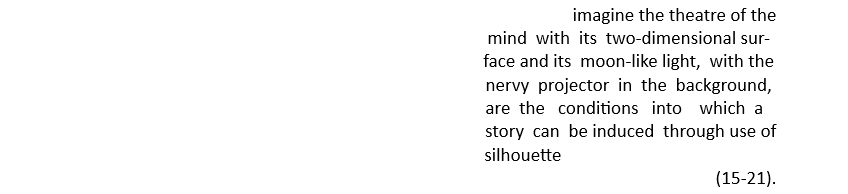
For a third time we are asked to “imagine” something, and we suddenly realise that these are imperatives, previously hidden by a conversational tone which becomes increasingly desperate as another cognitive shift takes place. The “mind’s walled / surface” (4-5) and the “ocular theatre” (6) of the second stanza in this excerpt merge to become the hybrid “theatre of the / mind” (15-16), the line break toying with us, making us wait for the revelation. The “two dimensional sur- / face” (16-17) is the same as in the first stanza, but the “light” is now “moon-like” rather than from a projector.
This “nervy projector” is still “in the background” (18), muttering away to itself, but the light source has become organic, unreliable. The moon changes and controls the tides, which also shift from day to day. It is famously a symbol of inconstancy, as Shakespeare’s Rosalind notes when pretending to be “a moonish youth” (3.2.394-5). The speaker here is both young and not, both light and shadow, and these “are the conditions into which a / story can be induced through use of / silhouette” (19-21). A silhouette is not a complete picture; even if it manages to be a clear shadow, it’s still only a shadow, like those in Plato’s cave.
These are the imperfect “conditions” in which memory has to work, and the speaker has pointed out their fallibility with the brutal clarity that imbues this work as a whole; but perhaps they are perfect for their purpose after all:
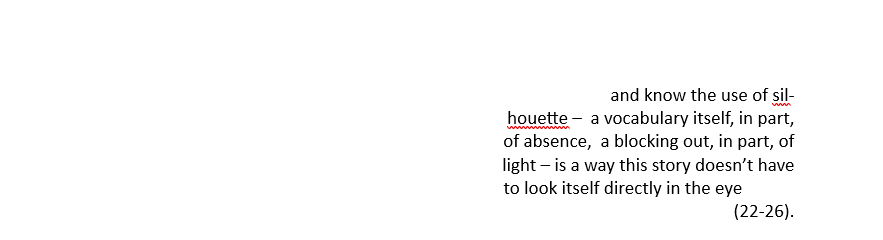
We are back to imperatives with “know” (22): we are told exactly what light and shadow mean in the context of this narrative. Like an erasure poem , a silhouette is: “a vocabulary itself, in part, / of absence, a blocking out, in part, of / light –” (23-25). It is a lack of words speaking volumes; an absence that denotes the presence of something unspeakable. Some memories can be expressed only by redaction; some truths must be told slant (Dickinson) lest they burn the mouth of the teller: “a way this story doesn’t have / to look itself directly in the eye” (25-26).
In my collection Crippled about my mum’s chronic illness with Multiple Sclerosis, her death and the grieving process, I use the sonnet form for the first half of the book. As I noted in an article for poetry/science journal Consilience on poetic form and trauma, “Writing in form allowed me to dissociate, to communicate pain without feeling it”. The poems that arrived after her death, however, came in their own shapes: “Form becomes formless: the white space suffuses the text … In On Poetry, Maxwell suggests that poets consider ‘Whatever the whiteness is to you’ (54). For me, it has always represented emotion, and in these poems it’s loss: both the literal absence of my mum and my own inability to express this absence with words; white space as aphasia.” In RABBITBOX, Holloway-Smith enacts a poetic alchemy which transforms this aphasic white space into its negative: a silhouette that both redacts and communicates.
*******
Something I like to do when reading poems is to see what poem is created by the end words, a kind of golden shovel in reverse. Here’s the end word poem from this excerpt, keeping any punctuation, with a line for each stanza. What most comes out are the hesitations enacted in the hyphenated words split by line breaks, and the contradictions inherent in juxtapositions such as “walled” and “light”, “narrator” and “alternative”:
and directly surface

walled light in performed

back- its ner- narrator alternative needs say

the sur- the background, a of silhouette

sil- part, of have eye
*******
Each week, I’ll share a poem of my own if I think I’ve one which chimes with the poem under discussion. Here’s “Gretel”, the opening poem from my collection Crippled, available from Red Squirrel Press, or DM me to purchase a signed copy.
Gretel

We are our own mythologists
within the quicksand history of the mind.
That time I plunged my sticky toddler fist
into the formula is redefined

three decades on. You say the milk was free
because we were hard up: Dad out of work
five months into your second pregnancy.
I thought it started later; all the hurt

safely labelled by my memory –
his jobs, your health. When you were diagnosed
I knew it was my fault, but now I see
the crime was earlier than I supposed.

There’s nothing I can do. The milk is spilt.
Lost in the woods, I dodge the witch of guilt.

Suzanna Fitzpatrick
I’ll be performing my poetry burlesque show, Fickle Puck, at the Midlands Fringe Festival: Saturday 25 July 2026, 5.45pm, The Pack (Perfect Ale, Cask and Keg), 25-26 Queen Square, Mander Centre, Wolverhampton, WV1 1TQ. Just turn up, pay-as-you-feel. https://www.midlandsfringe.co.uk/shows/25thjuly2026.
Works Cited
Dickens, Charles. A Christmas Carol. The Christmas Books Volume One. Penguin, 1987.
Dickinson, Emily. “Tell all the Truth but tell it slant – (1129).” The Complete Poems of Emily
Dickinson, edited by Thomas Herbert Johnson, Little, Brown and Company, 1976, p. 506.
Eliot, T. S. “The Wasteland.” Collected Poems 1909-1962. Faber, 1963, p. 79.
Fitzpatrick, Suzanna. “Safety in Chaos: Poetic form as a means of processing trauma.” Consilience, 14 July 2025, consiliencejournal.substack.com/p/safety-in-chaos?utm_campaign=post-expanded-share&utm_medium=web&triedRedirect=true. Accessed 16 July 2026.
Holloway-Smith, Wayne. “Poetry at the Next Level: Advanced Workshop”. 13 July 2026, on Zoom. Notes taken by me.
Maxwell, Glyn. On Poetry. Oberon Books Ltd., 2012.
Modern Physics. “Shadowgraph.” Modern Physics, modern-physics.org/shadowgraph/. Accessed 16 July 2026.
NHS. “Aphasia.” NHS, 1 April 2025, www.nhs.uk/conditions/aphasia/. Accessed 16 July 2026.
Poetry Foundation. “Erasure Poetry.” Poetry Foundation, www.poetryfoundation.org/education/glossary/erasure-poetry. Accessed 16 July 2026.
Taylor, Joelle. Reading and discussion for Well Versed on 17 September 2025, on Zoom via the StAnza festival. Available at youtu.be/Wm5HaynBtDo?si=VPy3T6FKUI3Z4FqB. Accessed 16 July 2026.
Shakespeare, William. As You Like It. The Complete Works of William Shakespeare. OUP, 1994, pp. 627-52.
Wikipedia. “Shadowgraphy (performing art).” Wikipedia, en.wikipedia.org/wiki/Shadowgraphy_(performing_art). Accessed 16 July 2026.
Wikipedia. “Allegory of the cave.” Wikipedia, en.wikipedia.org/wiki/Allegory_of_the_cave. Accessed 16 July 2026.
Winterson, Jeanette. The Passion. Random House, 2001.
I think with you at the helm, The Deeper Read can do justice to any kind of poem, Suzanna! Great analysis as always.