The Deeper Read 29
Roger Bloor

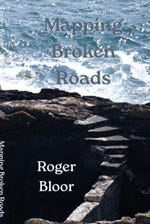
“CRITERION A: STRESSOR”; “CRITERION B: INTRUSION SYSTEMS”; “CRITERION C: AVOIDANCE”; “CRITERION D: NEGATIVE ALTERATIONS IN COGNITIONS AND MOOD”; “CRITERION E: ALTERATIONS IN AROUSAL AND REACTIVITY” from Mapping Broken Roads (Barnard Publishing Ltd., 2026).
Roger’s website is here.
Content note: Post-traumatic stress disorder (PTSD).
Help can be found at PTSD UK or Mind.
CRITERION A: STRESSOR
CRITERION B: INTRUSION SYMPTOMS
CRITERION C: AVOIDANCE
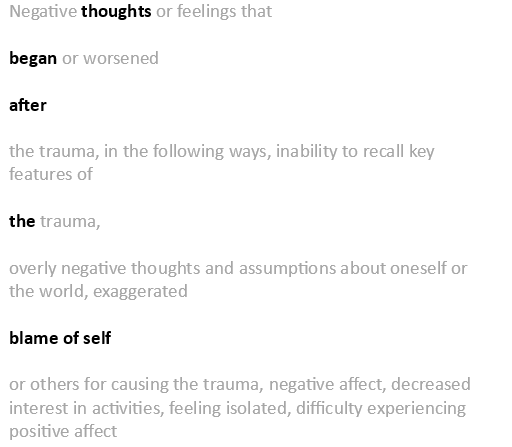
CRITERION D: NEGATIVE ALTERATIONS IN COGNITIONS AND MOOD
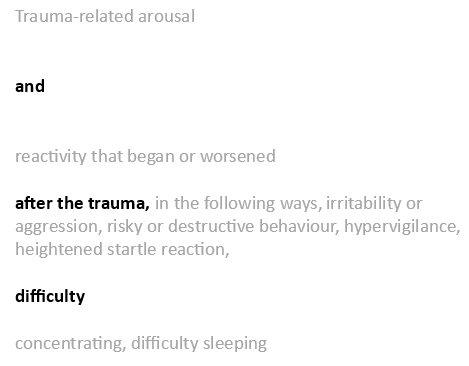
CRITERION E: ALTERATIONS IN AROUSAL AND REACTIVITY
Roger Bloor
This sequence of five poems is spread throughout the collection on pp. 59, 65, 79, 87, 94.
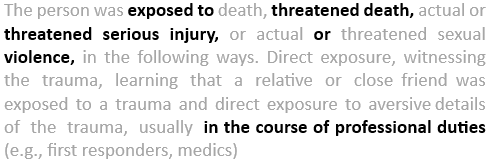
At the start of Mapping Broken Roads, Bloor quotes Susannah Radstone on trauma theory: “Trauma theory’s topography of the inner world has been described as consisting of ‘a conscious mind in which past experiences are accessible, and a dissociated area of the mind from which traumatic past experiences cannot be accessed.’”. The “CRITERION” sequence of poems, spread throughout the central section of the book like flashbacks, examines this duality of conscious and unconscious by taking found diagnostic text and turning it into erasure poems, deftly using medical language and its deletion to embody dissociation; something all the more poignant as Bloor is a retired consultant psychiatrist as well as a poet. The ghostly presence of the unconscious is signalled in the way that, unlike traditional erasure texts, Bloor greys out but retains the words he wishes to keep in the background whilst putting in black text those words he wants to foreground, effectively creating a double poetry. There is still white space around and in some cases within these poems, but effectively what appears empty is in fact filled by the dark matter of the unconscious, creating a sense of a mind under unbearable strain.
The titles are deliberately clinical, each detailing a different ‘criterion’ of PTSD, moving through the symptoms as they are experienced. The speaker is not there in a conventional sense; rather, they speak through the highlighted words in the found text, as if sending a distress signal using the dots and dashes, the light and darkness of morse code. “CRITERION A: STRESSOR” introduces us to the initial trauma. The medical definition lists a number of ways in which this could happen, but the speaker communications their personal experience to us through the words which remain when the rest of the source text is greyed out: “exposed to threatened death, threatened serious injury, or violence, in the course of professional duties”. Poignantly, they do not highlight the nature of their job, leaving “(e.g., first responders, medics)” both greyed out and in parentheses. It is as if their professional persona cannot bear to admit that the unthinkable has happened to them; a double dissociation. There is no full stop at the end of this poem; in fact, Bloor rarely uses full stops at the end of any poem in this collection: these are all ongoing explorations.
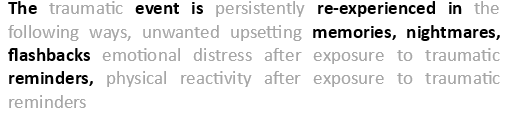
“CRITERION B: INTRUSION SYMPTOMS” moves on from the initial traumatic event to its effect on the person who experiences it. Once again, this practitioner finds themself only able to speak through the language of their profession: a profession, it is implied, which should have been safeguarded but wasn’t. They list their own symptoms passively by allowing them to emerge, as if from the unconscious, out of the greyed-out text: “The event is re-experienced in memories, nightmares, reminders,”. Bloor deftly uses the catch-all tautology of medical texts to embody the repetitive nature of PTSD, and the many ways in which it can ambush a mind: what is a memory, if not a reminder, welcome or unwelcome?

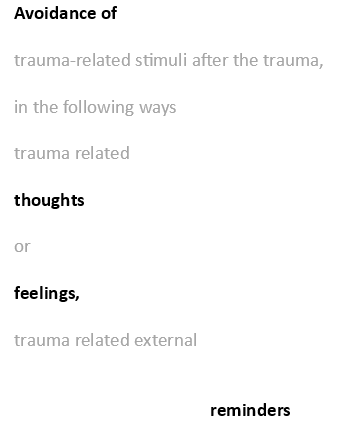
In the next poem of the sequence, “CRITERION C: AVOIDANCE”, the prose poem form begins to break down as the conscious mind struggles to retain control. Having established in the preceding poem the many-headed nature of their traumatic hydra, the speaker desperately clings to one plan: “Avoidance of thoughts feelings, reminders”. These are the only words not greyed out in this poem: it is telling that its majority consists of the several ways in which these lurking reminders may arrive, all of them “stimuli” impossible to avoid. The impossibility of existing in a world which has been turned into a minefield is bluntly delineated, emphasised by the anaphora of ‘trauma’ and ‘trauma related’. As the word is repeated to the point of semantic satiation, we become aware of just how drawn-out the ‘au’ [aʊ] diphthong is, turning the word into a hollow groan.
So far, the titles have been succinct; now they lengthen as the poems grapple with the complexities of the experience they describe. In “CRITERION D: NEGATIVE ALTERATIONS IN COGNITIONS AND MOOD”, the highlighted words demonstrate just how difficult it is for a patient to grasp what is happening to them, let alone a medic; something given added piquancy by the fact that the speaker is both: “thoughts began after the blame of self”. The speaker is a professional thinker; once their initial numbness subsides, it is “thoughts” that plague them more than the greyed-out “feelings”. All other symptoms literally fade into insignificance other than “blame of self”: this happened to them in a professional context, and they feel they should have seen it coming. It is a brutal portrayal of the speaker’s dual isolation: trapped both in trauma and blame.
Self-flagellation, of course, is a form of control; albeit a spurious one. The highlighted words in “CRITERION E: ALTERATIONS IN AROUSAL AND REACTIVITY” simply state: “and after the trauma, difficulty”, juxtaposed with agonising understatement against the bleached background of six symptoms, ranging from “irritability” to “destructive behaviour”. In the last of this sequence, the dissociation is complete: the speaker retreats into euphemism, unable either to shield themselves behind their professionalism or admit to the rawness of their feelings. The doctor has become the patient, and must accept this unfamiliar vulnerability in order to, in Bloor’s own words in his introduction: “discover a route back home from the house of silence.” These poems form part of this route, stark way-markers of the healing process.
*******
Something I like to do when reading poems is to see what poem is created by the end words, a kind of golden shovel in reverse. While “A” and “B” are erasure prose poems of found material, with “C”, “D” and “E” also being hybrid shape/list poems, Bloor has still made a decision as to which words he ends lines with. As ever, looking at these together is illuminating. I have created a line for each poem, keeping original punctuation as usual and in this case also keeping any erasure. There are some devastating juxtapositions, in particular in “B” with “nightmares, traumatic traumatic reminders”.
or sexual witnessing was details duties medics)
the nightmares, traumatic traumatic reminders
of trauma, ways, related thoughts or feelings, external reminders
that worsened after key of trauma, or exaggerated self decreased experiencing affect
*******
Each week, I’ll share a poem of my own if I think I’ve one which chimes with the poem under discussion. Here’s “Dose”, a found sonnet from my collection Crippled, available from Red Squirrel Press, or DM me to purchase a signed copy.
Dose

500 milligrams Cefalexin
300 milligrams Ranitidine
60 milligrams Nortriptyline
50 milligrams Pregabalin

20 milligrams Simvastatin
16 milligrams Tizanidine
10 milligrams Baclofen
and 5 milligrams Amlodipine

treat urinary tract infections,
high cholesterol, indigestion,
nerve pain, muscle pain, hypertension,
spastic cramps, poor circulation.

These are your rations to survive each day,
for now. Sleep, wake, begin again.

Suzanna Fitzpatrick
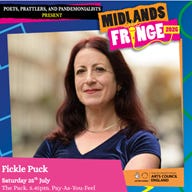
I’ll be performing my poetry burlesque show, Fickle Puck, at the Midlands Fringe Festival: Saturday 25 July 2026, 5.45pm, The Pack (Perfect Ale, Cask and Keg), 25-26 Queen Square, Mander Centre, Wolverhampton, WV1 1TQ. Just turn up, pay-as-you-feel. https://www.midlandsfringe.co.uk/shows/25thjuly2026.
Works Cited
NHS. “PTSD (post-traumatic stress disorder).” NHS, 8 April 2026, www.nhs.uk/mental-health/conditions/ptsd-post-traumatic-stress-disorder/. Accessed 21 July 2026.
Radstone, Susannah. “Trauma Theory: Contexts, Politics, Ethics.” Paragraph, vol. 30, no. 1, 2007, pp. 9-29. JSTOR, www.jstor.org/stable/43152697. Accessed 21 July 2026.
Wikipedia. “Semantic satiation.” Wikipedia, en.wikipedia.org/wiki/Semantic_satiation. Accessed 21 July 2026.
Thank you to you and Roger for highlighting the trauma that first responders and healthcare workers can be left with in the course of their duties... I think it's not talked about because professional bodies tend to be quite punitive when nurses, doctors etc. suffer from mental health problems. Erasure is therefore a great choice of form: what is hidden, what is seen.