The Deeper Read 30
Ellen McAteer

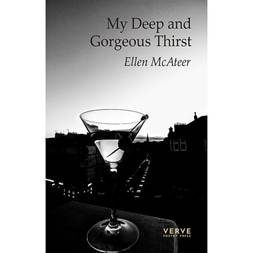
“Shoveling Bones” from My Deep and Gorgeous Thirst (Verve, 2024).
Ellen’s website is here.
Content note: alcoholism.
Help can be found from the NHS or from drinkaware.
Shoveling Bones

‘You think you are taking a clean sheet of paper, and it’s already covered with signs, illegible, as by a child’s hand.’
Rosmarie Waldrop

Three in the afternoon, daydreaming, you
feel the magic word Friday, and think
of that cold fire on the tongue, you
feel it licking your lips and belly, are
aware of the desert air that is taking
up space in your womb and liver like a
shout. You were doing so well, were clean,
till your son woke you asking why the sheet
was covered in tomato sauce, the lining of
your stomach colouring the bed like paper
scribbled over and over in red ink, and
you are trying to write a new story, but it’s
not possible, script has been written already,
here is your carpet, blotting paper covered
with smudges of brown crayon, spattered with
half-made out words, obscured strange signs,
canyons imprinted from other pages, illegible
but stamping and patterning your own story, as
you write, pen slipping into grooves set by
your parents, your plotline a juvenilia garden,
grubbed up, garbled like a child’s version
of a faerie tale, written with guided hand.

Ellen McAteer
The name and cover picture of McAteer’s debut collection hint at one of its main themes: the speaker’s ambivalent relationship with alcohol. In a similar fashion, both the title and epigraph of this poem give us clues as to what lies in store. “Shoveling Bones” implies a kind of metaphorical archaeology; but is the speaker digging up the past, or does the past continue to rake them over daily? Cryptic crossword style, there is also a nod to the poem’s form: a golden shovel, devised by Terrance Hayes in 2010 as a tribute to Gwendolyn Brooks. As noted in the end word section here, McAteer does deviate from the form in lines 21 and 22, but otherwise adheres to it, taking all the other end words from the Waldrop quote, flavouring the poem with the impossibility of ever having a completely clean start. Whether in life or in art, what has gone before us, even before we were born, creeps in.

After this philosophical opening, the poem’s first line brings us down to earth with a bump. We may be “daydreaming”, musing on the influence of the past on humans individually and collectively, but right now we are suddenly dropped into a specific point in time – “Three in the afternoon,” – and a specific, troubling ‘daydream’: that of the addict. The first six lines of the poems enjamb breathlessly into the start of the seventh as the craving takes hold before either reader or speaker realise:
Three in the afternoon, daydreaming, you
feel the magic word Friday, and think
of that cold fire on the tongue, you
feel it licking your lips and belly, are
aware of the desert air that is taking
up space in your womb and liver like a
shout.
(1-7).
The golden shovel form can make for awkward line breaks, but in this poem these intensify the addict’s feeling of alienation, even from their own life; something also conveyed by the use of the second rather than the first person pronoun. This uneasiness is ramped up by the tension between parsing and annotating lines (Longenbach 69); whilst every line so far runs on, the caesurae pause the narrative enough so that the full impact of what is happening hits home. It’s only 3pm. The speaker is “daydreaming”. Of what? It’s being “Friday”, which ‘magically’ gives an excuse for daytime drinking (2), although we are not told this explicitly. The act, the substance, cannot be named; the image of “cold fire on the tongue” stands as paradoxical euphemism. Its control over the speaker is subtly evoked; the imagery moves rapidly from the speaker’s own “tongue” (3) to the personification of the drink itself as a tongue: “licking your lips and belly” (4). Once it has been allowed in, the only thing the speaker can think about is all the space in their body that they need it to fill; a devastating portrayal of the physical as well as the emotional aspects of addiction: “the desert air that is taking / up space in your womb and liver like a / shout.” (5-7). The way in which the golden shovel form makes us wait on the knife-edge of a dune for “shout” is especially effective; the craving screaming from the speaker, even from the very liver it will damage.

Another internal organ is also mentioned: “womb” (6). We now know the speaker is female; we also wonder, given her emphasis on this organ, whether she is a mother. The next line makes this devastatingly clear. From now until the end of the poem is one sixteen-line sentence, with all but three lines (7, 13, 16) enjambing. The relapse is embodied in this early volta, and the poem careers off wildly as the speaker also leaves the rails of her attempt at sobriety. Nonetheless, the remainder of the poem still splits tonally. Lines 7 to 11 shift from the immediacy of the present tense to the past as we wake, disoriented, with the hungover speaker:
           You were doing so well, were clean,
till your son woke you asking why the sheet
was covered in tomato sauce, the lining of
your stomach colouring the bed like paper
scribbled over and over in red ink,
(7-11).
The double use of “were” in line 7 hits us with the fragility of addiction recovery; how months or even years of effort can be undone in an instant. There is a brutal ellipsis between lines 7 and 8; between “were clean,” and the aftermath, the shame of the speaker’s own child waking them from an alcoholic near-coma to ask “why the sheet / was covered in tomato sauce,”. The speaker – and therefore us – has no memory of what has elapsed between the Friday afternoon craving and now: the horror of bloody vomit on a sheet being interpreted by a child’s innocence as ketchup. This obliquely tells us that the son is as vulnerable as his mother; he is young enough to make such a mistake, and neither us nor she knows what he has been doing while she was unconscious.
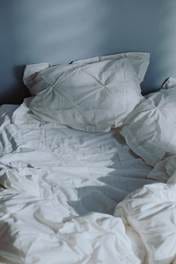
These are the “signs, illegible” of the Waldrop epigraph: signs of addiction that her son is too young to understand. We wonder who else in her life has missed the indications that she is struggling, even though they are “scribbled over and over” (11); the literally visceral image of expelled stomach lining deftly turned into a metaphor for the repetitive nature of addiction.
We have reached the midpoint of the poem, and its second half returns to the present tense, though dogged by the past as the speaker grapples with trying to seize control of her story despite the plot she senses she already carries inside her:
                                                              and
you are trying to write a new story, but it’s
not possible, script has been written already,
here is your carpet, blotting paper covered
with smudges of brown crayon, spattered with
half-made out words, obscured strange signs,
canyons imprinted from other pages, illegible
but stamping and patterning your own story, as
you write, pen slipping into grooves set by
your parents,
(11-20).
The present continuous of “you are trying” (12) makes us feel her ongoing struggle, brought up short by the switch to present simple with “it’s / not possible” (12-13); the golden shovel line break adding an extra jolt. We switch again to the present perfect, told curtly, with no definite article: “script has been written already,” (13), and another shift from the metaphorical to the physical starkly hammers this point home with an unflinching depiction of the havoc wreaked in the domestic setting by addiction: “here is your carpet, blotting paper covered / with smudges of brown crayon,” (14-15). McAteer mixes the metaphorical with the literal to devastating effect: dried bodily fluids poignantly reminiscent of a child’s “crayon”, the “blotting paper” of the carpet a dual metaphor for the extent of the suffering that the speaker also has to soak up.

Now the speaker takes off into the realms of psychology and philosophy, considering the nature of free will, genetics and intergenerational trauma, though she does not say as much, instead boldly stretching her writing metaphor as far as it will go; in the words of Joelle Taylor, “until it snaps in your face”. McAteer guides us effortlessly from “half-made out words, obscured strange signs,” (16) – reminiscent of a child’s confusion when learning to read and linking the image of a scholar with that of a sufferer trying to decipher the Rosetta Stone of their addiction – to the physical geography of “canyons imprinted from other pages, illegible / but stamping and patterning your own story,” (17-18). Canyons are not only vast but created over millennia (National Geographic); an image hinting at the scale of the problem faced by the speaker. The marks “from other pages” – maybe her parents, maybe going back for generations and genes long before them – may be “illegible” (17), but they are powerful; perhaps all the more so for being as yet undeciphered. Either way, the sense is that they are toying with her, “stamping and patterning your own story” (18), the repeated assonance of the “a” vowel sound giving a slapping feel. Even as she writes, she feels her “pen slipping into grooves set by / your parents,” (19-20), the twin ravines of nature and nurture, “canyon” punningly referring back to “crayon”.
At this point McAteer deviates from the golden shovel form, choosing her own end words for the antepenultimate and penultimate lines before returning to share the final word from the Waldrop quote:
                    your plotline a juvenilia garden,
grubbed up, garbled like a child’s version
of a faerie tale, written with guided hand.
(20-22).
The speaker may be trying to create her own “plotline”, but is stuck in a loop that persists from her childhood, a “juvenilia garden” that cannot mature healthily, repeatedly “grubbed up” by recurrent trauma. Her story is “garbled” by a teller who is doomed, like her own son earlier in the poem, to misinterpret important markers. The choice of the archaic spelling for “faerie tale” (22) is telling: this narrative has more in common with the Grimms’ eerie fables of doomed innocence than with Disney. The final image of the speaker having “written with guided hand.” is bleak. She knows she is being controlled, but can she break free? In choosing to write into the constraint of a golden shovel but departing from it with the words “garden” and “version”, McAteer’s speaker both references and defies the Edenic myth of an irreversible fall and hints at a redemptive retelling.
*******
Something I like to do when reading poems is to see what poem is created by the end words, a kind of golden shovel in reverse. Here’s the end word poem from this piece, keeping any punctuation; as the original poem is in one block, so too is the end-word poem. This immediately reveals the poem to be a golden shovel, as hinted at by the title, using the Waldrop epigraph as its source. It is completely faithful to the Waldrop line right up until the last three lines, where it deviates in lines 20 and 21 before concluding with the same word as Waldrop, “hand”, in the final line. The significance of this is more than McAteer simply choosing to leave her own stamp on the form; it also embodies the poem’s message that the ‘scripts’ we try to write with our own lives “Gang aft agley,” to quote Burns, insisting on following patterns inherited from our childhoods or even intergenerational trauma.
you
think
you
are
taking
a
clean,
sheet
of
paper
and
it’s
already,
covered
with
signs,
illegible
as
by
garden,
version
hand.
*******
Each week, I’ll share a poem of my own if I think I’ve one which chimes with the poem under discussion. Here’s “Travel Light”, first published in Finished Creatures issue 9 ‘Trespass’, edited by Jan Heritage.
Travel Light

The way you see, from a speeding train,
a person crossing a field: tiny, alone,
more shadow than body in winter sun –

less corporeal even than the horses
grazing in the adjoining paddock
while rooks gather in the branches

of flooded woods. There are bones:
the question is, whose. Does it matter
who buried them and how long ago –

are we more likely to be uneasy
if our new-builds teeter on the DNA
of Saxons, or Romans? Is Neolithic

more comfortable than Victorian,
and if we know a grave was ploughed
during the Middle Ages, is that better

or worse? There was a hoard of skulls
dug up once, scattered like marbles
when the Walbrook burst by Bedlam –

a wave of empty crania floating free
from heavy skeletons – sometimes
it helps to let the head go by itself.

Suzanna Fitzpatrick
Works Cited
Burns, Robert. “To a Mouse.” Poetry Foundation, www.poetryfoundation.org/poems/43816/to-a-mouse-56d222ab36e33. Accessed 29 July 2026.
Longenbach, James. The Art of the Poetic Line, Graywolf Press, 2008.
National Geographic. “Canyon.” National Geographic, education.nationalgeographic.org/resource/canyon/. Accessed 29 July 2026.
Poetry Foundation. “Golden shovel.” Poetry Foundation, www.poetryfoundation.org/education/glossary/golden-shovel. Accessed 29 July 2026.
Poetry Foundation. “Gwendolyn Brooks”. Poetry Foundation, www.poetryfoundation.org/poets/gwendolyn-brooks. Accessed 29 July 2026.
Poetry Foundation. “Rosmarie Waldrop.” Poetry Foundation, www.poetryfoundation.org/poets/rosmarie-waldrop. Accessed 29 July 2026.
Poetry Foundation. “Terrance Hayes.” Poetry Foundation, www.poetryfoundation.org/poets/terrance-hayes. Accessed 29 July 2026.
Taylor, Joelle. Reading and discussion for Well Versed on 17 September 2025, on Zoom via the StAnza festival. Available at youtu.be/Wm5HaynBtDo?si=VPy3T6FKUI3Z4FqB. Accessed 29 July 2026.