The Deeper Read 7
Sandra Galton

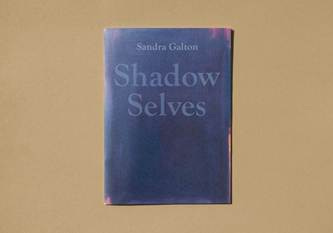
“Vanishing Point”, from Shadow Selves (Green Bottle Press, 2020), available from Green Bottle Press. Sandra’s debut novel, Cracks in a Frozen Sea, was published in 2025 and is available from TSL Publications.
Vanishing Point
after "Mystery and Melancholy of a Street" by Giorgio de Chirico

The girl is thrown into the light
but the sun feels almost set, like the girl
running, spinning a hoop past long shadows,
shadows of a past whose eyes’ black holes
frame unsighted questions, which is why
her hoop must go on spinning with the Earth

because, who knows, unless it spins, the Earth
may cease to shine its fulvous light
upon her spindly shape, blind as yet to why
or what she is except that she’s a girl
running with a hoop with a hole
in its middle and, that she, drawn from shadow

is being summoned by some larger shadow
from the cellar of the Earth
towards which she runs, a Self not yet whole
but cast out of darkness, pulled by light’s
promise, a mere figure of a girl
throwing questions to the world such as why

an unpeopled street, a horsebox yet no horses, why
the past in its vanishing exists as shadow
impossible to meet, and is it possible for a girl
to reach the cellar of the Earth
once the sun’s drawn a blind across its light
spinning itself into a black hole

on a katabasis to a place where the whole
of consciousness begins and ends, why
would any star or architect of light
choose to ignore the history of its shadow,
pastpresentfuture, while wrapping the Earth
as though it were a gift to draw a girl

up an unseeing street, or is it down for the girl
who herself may vanish to become a hole
in a hoop just as the Earth
may cease to spin in space, yes why
did the architect create shadow
if not in order to cast us all towards the light

with the half-seen girl who now sees why
to be whole she must run to find her shadow
before Earth reaches to turn out the light.

Sandra Galton
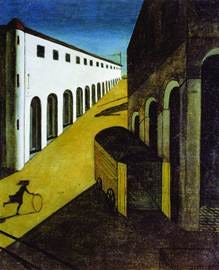
“Mystery and Melancholy of a Street” by Giorgio de Chirico (1914, private collection)
This week’s poem is a double whammy: ekphrasis and a sestina. There is more to unpack here than is possible in one post, so I will do my best to give an overview. The OED defines ‘ekphrasis’ as “a literary device in which a painting, sculpture, or other work of visual art is described in detail”. This is a rather basic definition which I feel would be disputed by many poets. Both Galton and I have worked with Tamar Yoseloff, who is rightly admired for her ekphrastic practice, and she has taught me that the best ekphrastic poems don’t merely describe the artwork but use it as a jumping-off point for exploring the poet’s own response to the artwork. The poem should stand as a work on its own; I hesitated to include the picture here, as Galton’s poem certainly does work independently, but I thought it might be helpful. A sestina is defined on the Poetry Foundation website as:
A complex French verse form, usually unrhymed, consisting of six stanzas of six lines each and a three-line envoi. The end words of the first stanza are repeated in a different order as end words in each of the subsequent five stanzas; the closing envoi contains all six words, two per line, placed in the middle and at the end of the three lines.
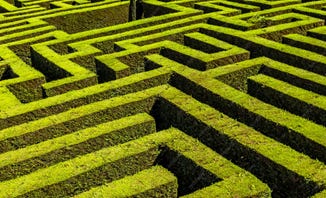
There’s a diagram to show the pattern of repetition. Anything which requires a diagram is not going to be an easy write; when I work on a sestina, I have to write out all the end words in the correct order to start with, or I get hopelessly muddled. So if a poet chooses this intricate form, the reader knows it’s for a reason. In this case, I think it’s two-fold. Firstly, Galton has made an intellectual decision to link a very structured repeating form with the style of the artwork which has inspired the poem; the reader, perhaps, is the girl, running past the shadowy archways of each stanza towards the “vanishing point” of the perspective. Things are not as they seem, however; de Chirico was a contemporary of M. C. Escher, and the painting plays a similar trick on its viewers: we are unsure whether to take the shadowed perspective or the sunlit one. Trying to do both gives a queasy feel; the embodiment of cognitive dissonance. I think that this is the second reason for choosing a sestina: its merry-go-round of repeating end words evokes a mind constantly turning something challenging over and over, as the girl bowls her hoop.

Galton plays on this as the poem progresses, the varied but relentless repetition making us feel we’re trapped in a labyrinth where nothing can be trusted and every attempt at progress loops us back to the start. It’s always worth looking at the end words a poet chooses for their sestina: firstly, they have to be strong enough to stand the repetition; and secondly, they reveal something about the poem. Five are monosyllables, giving a majority of lines a stressed ending. One end-word – “Earth” – is capitalised, taking us into the territory of eco-poetics; not earth as in soil, but Earth as in planet. Four of the words can be seen as opposing pairs in their connotations: the hopefulness of “light” and the youthfulness of “girl” juxtaposed with “shadows” and “holes”. Finally, “why” is a bold choice for an end word, but works very well in this context, signalling to the readers that this is a poem of “unsighted questions” (5), but not necessarily answers.
This ambivalence is present from the opening lines. We start off in the “light”, but we get there via the violent verb “thrown” (1) and are warned that “the sun feels almost set” (2). Like the girl, the readers have no agency: we are dropped into this strange scenario, as we are into life itself. We have to hit the ground “running” (3), and here is where Galton’s strength with craft becomes apparent: there are many more repetitions in this poem than those required by the sestina form. “Running” or “runs” appears in the first three stanzas and the envoi (3, 11, 15, 38). “Spinning” or “spins” occurs in stanzas one two, four, and six (3, 6, 7, 24, 34), and is echoed in “spindly” (9). We are dizzy and rushed, Galton whirling us through the poem as if we were the girl’s hoop; another repeated word (3, 6, 11, 33). There isn’t enough space here to look at how Galton’s soundscape contributes to this discombobulation, but doing so will repay the effort. As Glyn Maxwell once said in an MA seminar, vowels are the air in a poem, and here they’re less of a breeze and more of a tornado. Repeated sibilance contributes to this rushing feeling as we spin with the girl and her hoop.
We have no idea what we are “spinning” so helplessly towards, as another repeated trope is that of being unknowing, unseeing: “who knows”, begins the second stanza, and we feel complicit in its despairing shrug. We have learnt nothing from what has come before as we hurtle “past long shadows, / shadows of a past” (3, 4), the chiasmus neatly trapping us in its Möbius strip. These are shadows “whose eyes’ black holes / frame unsighted questions” (4, 5), their ignorance its own trap; if we aren’t even able to ask the right questions, we are doomed to receive the wrong answers, if any. A similar self-sabotage is implied in “the sun’s drawn a blind across its light” (23). Perhaps this self-sabotage is reminiscent of humanity’s refusal to acknowledge the experiences and rights of all its members; something implied by “half-seen girl” (37). Having been running for the whole of the poem, this protagonist finally, in the envoi, “now sees why / to be whole she must run to find her shadow” (37, 38). She is “a Self not yet whole”(15), and the only inhabitant of this eerily “unpeopled street” (19), save for “some larger shadow” (13) which beckons her and which, pace Jung, she must acknowledge in order to be complete: “Everyone carries a shadow, and the less it is embodied in the individual’s conscious life, the blacker and denser it is” (77).

Time is not on her side – we are all in a race to understand ourselves “before Earth reaches to turn out the light” (39), and she is also up against fate and a patriarchal society: “why / would any star or architect of light / choose to ignore the history of its shadow,” (26-8). There is an uneasy feel of predatory grooming in the “larger shadow” (13) which has “drawn” her out (12), beckoning her, Persephone-like, to “the cellar of the Earth” (14); but the challenge is greater than that. The faceless “architect” reappears in the penultimate stanza as the speaker muses whether this creator made shadow “in order to cast us all into the light” (36); “cast” taking us back to “thrown” at the very start of the poem, and reminiscent of being cast out.
Dumped unceremoniously into existence by our creator; expelled from Eden in the Judeo-Christian tradition for not being up to scratch, it’s small wonder we repeat this violence in “throwing questions to the world” (18) which we must ultimately answer for ourselves, our consciousness always in danger of “spinning itself into a black hole” (24); the self-harm of depression – denying one’s own humanity – or the harm to others of refusing theirs. As Galton herself said in an exchange we had about this Substack: “I feel this poem is particularly pertinent in a number of ways to the very fragile state of our world today.” The envoi’s end-words sum up our confusion: “why” “shadow” “light”. As Le Guin says, a child:
needs knowledge; he needs self-knowledge. He needs to see himself and the shadow he casts. That is something he can face, his own shadow; and he can learn to control it and to be guided by it. So that, when he grows up into his strength and responsibility as an adult in society, he will be less inclined, perhaps, either to give up in despair or to deny what he sees, when he must face the evil that is done in the world, and the injustices and grief and suffering that we all must bear, and the final shadow at the end of all (148).
Only by acknowledging and accepting our shadows can we live in wholeness, as individuals and as a society. In this psychologically and philosophically complex poem, Galton shows just how challenging that is; but, like the girl spinning her hoop in defiance of entropy, we have to try.

*******
Something I like to do when reading poems is to see what poem is created by the end words, a kind of reverse golden shovel. Here’s the end word poem from this piece, with a line for each stanza, keeping each word’s original punctuation. In a sestina, there is some leeway in terms of stretching the chosen words into a plural, a homophone, or by changing the conjugation of a verb, and it’s always interesting to see where and why a poet will choose to push against the form in this way.
light girl shadows, holes why Earth
Earth light why girl hole shadow
shadow Earth whole light’s girl why
why shadow girl Earth light hole
whole why light shadow, Earth girl
girl hole Earth why shadow light
(girl) why (whole) shadow (Earth) light.
*******
Each week, I’ll share a poem of my own if I think I’ve one which chimes with the poem under discussion. Here’s “Troll”, also a sestina, first published in US online journal River Heron Review in their Poems, for Now edition. I often use strict forms when writing about emotionally challenging subjects as a way of keeping myself safe; here, the repetition is also used to create a sense of entrapment: the troll seeks to snare women in harm through misinformation and is also trapped inside his own hatred. I took satisfaction in reclaiming words from the abusive post as end-words and turning them back against the perpetrator.
Content note: online trolling, violence against women.
Troll

Don’t panic about unexpected bleeding.
I’ve had it and was absolutely fine –
internal scan, biopsy of the womb –
was offered anaesthetic for the pain
but just cracked on with it, why bother?
It’s all just part of being a woman.

Admin reports this poster’s not a woman,
but used his wife’s account. If he’s bleeding
it’s not from a vagina, yet he’s bothered
to mansplain on what counts as fine
for female benefit. What a pain
to have such wisdom but no womb,

barring him from this group. So he fakes a womb
to access all the vulnerable women
who find society ignores their pain,
brands them taboo as soon as they start bleeding;
demands Smile, love and the brisk I’m fine
so that men will never have to bother –

or care – about the truth. But this one’s bothered
to comment on an unknown woman’s womb
and been found out. Exposure is his fine:
his profile picture shared to every woman
to warn us. He’s mid-life, tattoos bleeding
along each cheek, mouth set as if in pain

above a purple beard. The only pain
he’s felt has been from piercings, the bother
of chafing biker gear. His eyes are bleeding
contempt for every human with a womb.
Who took this photograph? Was it his woman?
I wonder if she knows, or thinks it’s fine

what he gets up to. Someone comments – fine,
but just why did he do it? It gives me pain
to tell her: here’s a man who so loathes women
that he will go to all the time and bother
of convincing us that he too has a womb
so he can tell us to ignore our bleeding –

a fine way to spread harm like unchecked bleeding,
abuse our wombs en masse without the bother
of going near us. Women deserve pain.

Suzanna Fitzpatrick
Works Cited
Jung, Carl Gustav. “Psychology and Religion: West and East.” The Collected Works of C. G. Jung, vol. 11, Bollingen Series XX, Pantheon, 1958.
Le Guin, Ursula K. “The Child and the Shadow.” The Quarterly Journal of the Library of
Congress, vol. 32, no. 2, 1975, pp. 139–48. JSTOR, www.jstor.org/stable/29781619. Accessed 27 December 2024.
Maxwell, Glyn. “Building Blocks of Form: Formal and Free.” Masterclass 1.8, 27 February
2024, The Poetry School. Seminar. Notes taken by me.
OED. “Chiasmus, N.” Oxford English Dictionary, Oxford UP, July 2023, doi.org/10.1093/OED/4667753900. Accessed 16 February 2026.
OED. “Ekphrasis, N.” Oxford English Dictionary, Oxford UP, June 2025, doi.org/10.1093/OED/9978811918. Accessed 16 February 2026.
Poetry Foundation. “Sestina.” Poetry Foundation, www.poetryfoundation.org/education/glossary/sestina. Accessed 16 February 2026.