The Deeper Read 9
Edward Thomas

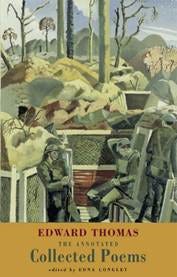
“Aspens”, from Edward Thomas: The Annotated Collected Poems, edited by Edna Longley (Bloodaxe Books, 2008.)
Aspens

All day and night, save winter, every weather,
Above the inn, the smithy, and the shop,
The aspens at the cross-roads talk together
Of rain, until their last leaves fall from the top.

Out of the blacksmith’s cavern comes the ringing
Of hammer, shoe, and anvil; out of the inn
The clink, the hum, the roar, the random singing –
The sounds that for these fifty years have been.

The whisper of the aspens is not drowned,
And over lightless pane and footless road,
Empty as sky, with every other sound
Not ceasing, calls their ghosts from their abode,

A silent smithy, a silent inn, nor fails
In the bare moonlight or the thick-furred gloom,
In tempest or the night of nightingales,
To turn the cross-roads to a ghostly room.

And it would be the same were no house near.
Over all sorts of weather, men, and times,
Aspens must shake their leaves and men may hear
But need not listen, more than to my rhymes.

Whatever wind blows, while they and I have leaves
We cannot other than an aspen be
That ceaselessly, unreasonably grieves,
Or so men think who like a different tree.

Edward Thomas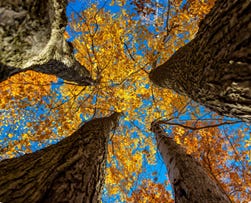
I usually focus on contemporary poetry in this Substack, but every so often I’ll go off-piste. This week marks 148 years since the birth of Edward Thomas on 3 March 1878. I was privileged to be awarded the Edward Thomas Fellowship’s Poetry Prize this year, and on 1 March attended their AGM and walk to Berryfield Cottage in Steep, where Thomas once lived and wrote. One of their members, Ben, kindly gifted me the wonderful Bloodaxe edition of Thomas’s work, edited by Edna Longley, and it struck me that “Aspens” is classic Thomas in that it not only draws on his deep affinity with the environment but also considers the role of the poet. One thing that the poets who have had the most impact on me have in common is that they take their craft very seriously, but themselves less so. Thomas is no exception.
The first thing we register is the orderliness of the poem on the page: as Glyn Maxwell says, “Creaturely movement towards an objective”; these are the measured footprints of a thought leaving its mark on the white space. By the end of the first stanza, we are aware of the consistent ABAB rhyme scheme and iambic pentameter metre (dee DUM dee DUM). These are elegiac stanzas, but as the poem unfolds in its unhurried way, the elegy is a subtle one. The speaker is not mourning a death or even a specific loss; rather, they are considering whether humanity – let alone the art produced by an individual human life – ultimately leaves a trace on the earth.

The very first line of the poem – “All day and night, save winter, every weather,” (1) introduces a timelessness embodied in the steady heartbeat of the iambics, and the second line – “Above the inn, the smithy, and the shop,” (2) sets us firmly in human habitation; as Longley observes in her notes to the Bloodaxe edition of Thomas: “not just literal buildings but also the loci of human community: social life, manufacture, commerce” (252). The third and final lines of this stanza, however, undercut our expectations with sly bathos: “The aspens at the cross-roads talk together / Of rain, until their last leaves fall from the top.” (3-4). The voices in the poem are not humans, but trees, and there is subtle humour in the deft line break. It could simply be a concrete image; the wind often gets up as a rain front sweeps in. However, there is a tenderness to Thomas’s humour here. It is as if he personifies the trees as village gossips – Longley references their “folk name ‘old wives’ tongues’” (251) – somehow part of the human community, keeping watch over it “All day and night” (1).

The soft rustle of the trees is counterpointed in the second stanza with the more strident sounds of human life, intruding from the premises already mentioned in the first stanza: “Out of the blacksmith’s cavern comes the ringing / Of hammer, shoe, and anvil; out of the inn / The clink, the hum, the roar, the random singing – ” (5-7). Humans are busy and noisy, whether at work in the smithy or at play in the inn. The onomatopoeia of “The clink, the hum, the roar,” (7) crescendos from a small sound made by one person to the “roar” of many; the chiming ‘A’ rhyme of “ringing” (5) with “singing” (7) intensifying the soundscape. It’s as if the industrial revolution is being compressed to a sonic nutshell in “The sounds that for these fifty years have been.” (8).
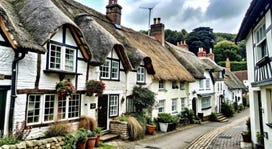
However, this line also takes in a broader historic scope: the “prehistoric ring” (Longley 252) of “cavern” (5) reminds us that humans once lived in caves. All this noisy progress is a recent innovation, and the implication is that it may even be a blip; the trees are certainly unfazed by the intrusion: “The whisper of the aspens is not drowned,” (9). As we reach the heart of the poem, it becomes clearer that this proto-elegy may well be for humanity itself; “Our tenure as ‘inhabitants of the earth’ may be in question” (Longley 252). The third stanza ostensibly describes the peace that falls over the village come night-time, but there is a sinister feel to Thomas’s description of “lightless pane and footless road” (10).
As I mentioned in The Deeper Read 5, about Glyn Maxwell’s poem “The Ledge”, Maxwell himself has observed that “If you talk about something that isn’t there in a poem, it is there, because you’ve mentioned it. So if you talk about absence, absence becomes a solid: an absence of absence” (Workshop 5). The repetition of the suffix ‘-less’ emphasises the absence of human life in this scene; there is none of the rowdy soundscape of the second stanza, not even a footstep. Light itself has vanished, in a reversal of the first act of creation in Genesis 1:3. That the road is “Empty as sky” (11) is a telling simile. Of course, in Thomas’s time the sky had yet to be as thoroughly colonised by human machinery as it has now; nonetheless, the sky existed before humans and will remain after we have gone. This feeling deepens with the observation that, although the people in the poem are finally silent, the trees continue their conversation with each other and “with every other sound / Not ceasing” (11-12).
This permanence is accentuated by the rare run-on between these lines. It’s worth noting at this point that, of 24 lines, 16 are end-stopped; two-thirds of the total. This is part of how Thomas gives the poem its meditative feel: allowing us plenty of time to take in what he is saying, in sympathy with the quiet patience of the trees. It also means that when enjambment does occur it is more impactful, and we are drawn to examine why these particular lines run on. I have already noted the bathetic humour of “together / Of rain” (3-4) in the first stanza. In the second stanza, the enjambment between lines 5-7 makes the crescendo of noise seem inevitable, almost overwhelming. Here, breaking between “sound” and “Not ceasing” (11-12) paradoxically throws into relief the fact that, whatever the humans are up to, there is no break in the sound of the trees, nor in the life of the natural world.
Humans come and go, humanity will come and go, and this night-time is of course a metaphor for death or even extinction; something stressed by the only run-on between stanzas in the poem, as the sound of the trees “calls their ghosts from their abode, / A silent smithy, a silent inn,” (12-13). Thomas’s skill here is in extending one sentence over two stanzas and eight lines, all the way from his assertion that “The whisper of the aspens is not drowned,” (9) to “To turn the cross-roads to a ghostly room.” (16). The sibilant “whisper of the aspens” (9) is more powerful than any human clatter; it never “fails” (13), but continues through its own changes and cycles, whether in “the bare moonlight or the thick-furred gloom,” (14) or “In tempest or the night of nightingales,” (15).
That this run-on builds to the metaphor of “a ghostly room” (16) is telling. It appears to be a continuation of the personification of the trees as speakers, but implies that humanity’s legacy may well come down to deserted habitations, echoing Shelley’s Ozymandias: “Nothing beside remains. Round the decay / Of that colossal Wreck, boundless and bare / The lone and level sands stretch far away” (12-14). The “cross-roads” are both literal and metaphorical. Linda Hart notes: “Thomas wrote ‘Aspens’ in July 1915 and immediately sent it to Frost, with the letter containing the news that he had enlisted.” Humanity is at the crossroads of the First World War, and Thomas is at his own personal crossroads. Aged 37, he has not been conscripted but has chosen to enlist; a decision which will lead to his death in the Battle of Arras on Easter Monday in 1917 (Edward Thomas Fellowship).
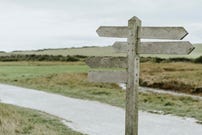
Thomas moves on from the central two stanzas of the poem – its crossroads – breaking the enjambment which epitomises the heavy inevitability of the approach of war and the obligation he feels to take part. Syntactically, it would make sense to continue the run-on into the fifth stanza, but instead its first line stands as a sentence on its own: “And it would be the same were no house near.” (17). Here the previous humour shifts to a quiet despair as Thomas considers his role as a poet. The world turns: history passes with “all sorts of weather, men and times,” (18) – the iambics landing with a doomy heaviness – “Aspens must shake their leaves and men may hear / But need not listen, more than to my rhymes.” (19-20). The trees aren’t listening to the humans; only the poet is listening to the trees; is anybody listening to the poet? It’s tempting at this point to go into the inn, pour us both a drink and say ‘we’ve all been there, mate.’ It’s a testament to his lack of ego that only now does the speaker refer to himself with “my rhymes” (20); the final stanza is the first time that “I” appears (21), whereas “aspens” appears in four out of six stanzas (3, 9, 19, 22); he is content to let the trees speak for him.
This ventriloquism notwithstanding, Thomas sets out his poetic manifesto in the final stanza, joining with his arboreal comrades to state: “Whatever wind blows, while they and I have leaves / We cannot other than an aspen be / That ceaselessly, unreasonably grieves,” (21-23). The wind is notoriously fickle, a metaphor for changeability. In contrast, whilst both trees and poet may sway with it, their song persists, strengthened by the enjambment, the iambics embodying the sobbing of elegy in a line where, as Longley notes, “The sibilant music that spreads out from the word ‘aspens’ … reaches is climax in ‘ceaselessly, unreasonably’” (252). Leaves can’t help but whisper when disturbed; a poet can’t help but “grieve” for the harm humanity does to itself and the planet.
Perhaps it is not grief at all; the wry humour returns with a quiet determination in the final line of the poem: “Or so men think who like a different tree” (24). Each to their own, but perhaps what one person interprets as moaning, another may understand as celebration, because truly loving something involves an acceptance of its potential loss, and yet another may see this as a battle cry to protect the thing that is loved. Unlike the blacksmith or the innkeeper – which are valuable jobs, of course – poets don’t do this for the money, more fool us. We do it because we are compelled to, and because we care: perhaps unreasonably, but certainly ceaselessly and desperately.
*******
Something I like to do when reading poems is to see what poem is created by the end words, a kind of reverse golden shovel. Here’s the end word poem from this piece, with a line for each stanza, keeping each word’s original punctuation.
weather, shop, together top.
ringing inn singing – been.
drowned, road, sound abode,
fails gloom, nightingales, room.
near. times, hear rhymes.
leaves be grieves, tree.
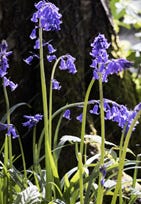
Each week, I’ll share a poem of my own if I think I’ve one which chimes with the poem under discussion. Here’s “This spring”, which was awarded First Prize by Daljit Nagra in this year’s Edward Thomas Fellowship Poetry Competition. Like Thomas, I often find inspiration in nature, and what I think links these two pieces is that they each consider, in their own way, the dynamic between humans and the natural world. The irony in my poem is that a very difficult time meant I was unable to get outside and see the bluebells; nonetheless, their sustaining presence is there the whole way through the poem. Spoiler alert: we did all survive those particular challenges. Thank you, NHS.
This spring

I miss the bluebells, but find blue elsewhere:
the scuffed plastic of a waiting room chair

the light from my phone as I message family
those concertina curtains – neither fabric

nor paper – offering scant privacy
my father’s eyes, blue over a blue mask

the purple-blue of the angiogram dye
the dancing blue numbers of his SpO2

the code blue he so nearly was.

So many signs in NHS Blue
(Pantone 300) directing my days:

A&E, Cardiology, Paediatric Allergies
(my son’s new epi pen instructs blue to the sky

orange to the thigh), Radiography, the teal
of my husband’s MRI, Surgical,

my striped hospital gown, the blankets
they pile on me as I shudder with shock

the blue-black bruise the surgery leaves.

Suzanna Fitzpatrick
Works Cited
The Holy Bible. New International Version, Hodder and Stoughton, 1990.
The Edward Thomas Fellowship. “Edward Thomas (1878-1917).” The Edward Thomas Fellowship, edward-thomas-fellowship.org.uk/edward-thomas-life/. Accessed 4 March 2026.
Hart, Linda. Once They Lived in Gloucestershire: A Dymock Poets Anthology. Green Branch Press, 2000. Quoted on Friends of the Dymock Poets, dymockpoets.org.uk/edward-thomas/#:~:text=Thomas%20wrote%20’Aspens’%20in%20July,news%20that%20he%20had%20enlisted. Accessed 4 March 2026.
Maxwell, Glyn. Workshop 5, 28 January 2025, The Poetry School, London. Seminar. Notes taken by me.
---. “A View with a Room: my closing remarks.” Silly Games to Save the World, 28 April 2025,
glynmaxwellgmailcom.substack.com/i/162190614/there-will-be-two-more-posts-relating-to-the-poetry-and-psychotherapy-conference-i-organised-by-mistake. Accessed 4 March 2026.
Poetry Foundation. “Glossary of Poetic Terms: Elegy.” Poetry Foundation,
www.poetryfoundation.org/education/glossary/elegy. Accessed 3 March 2026.
Shelley, Percy Bysshe. “Ozymandias.” The Works of P. B. Shelley. Wordsworth Editions, 1994.
Thomas, Edward. The Annotated Collected Poems. Bloodaxe Books, 2008.